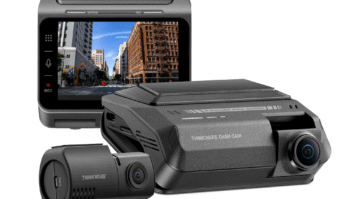
Looking for a tech product to attract younger male urban customers? The folks at car insurance aggregator Autoinsurance.com suggest you consider selling dash cams.
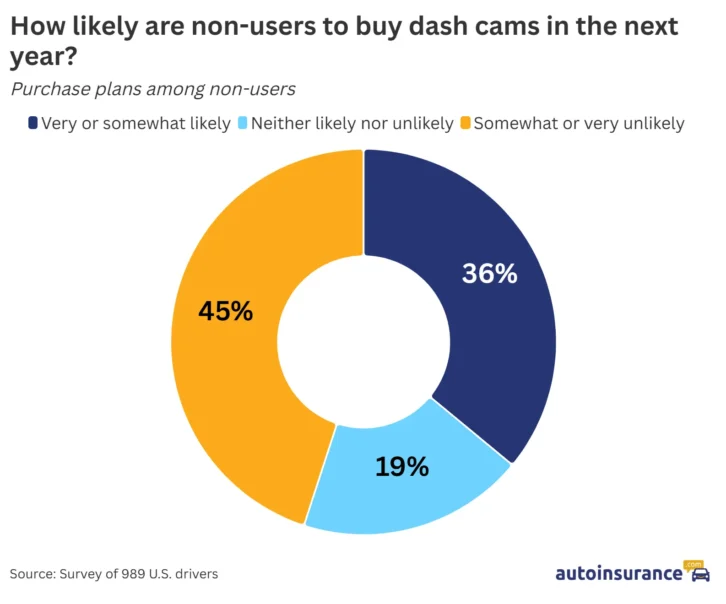
According to results of a survey Autoinsurance.com conducted this summer, an estimated 57.8 million U.S. drivers plan to buy a dash cam within the next year, with 45% of Gen Zers surveyed saying they’re likely to buy one. Overall, 36% of non-dash cam owners are very or somewhat likely to buy one.
Other than male urban Gen Zers, the survey says rideshare/delivery drivers represent 53% are the most likely to buy a dash cam, an opportunity for a retailer to grab some commercial sales. Around 40% of urban residents are likely to buy compared to just 28% of suburban drivers and only 19% of rural residents.
 So, what’s driving (pun intended) these growing dash cam sales? Legal liability, mostly. According to the survey, “four in 10 dash cam users have already captured at least one crash or traffic event on video, and half of those clips (from nearly one in five owners overall) have been used for insurance claims or other legal matters.”

“Just for liability reasons, you just want to be able to show that you had a camera on what was going on,” opines Maya Afilalo, managing editor and industry analyst for AutoInsurance.com. “You get into an accident and, if you have a dash cam, both drivers can’t say, ‘well, I had the green light.’ The dash cam is going to say which driver had the green light, which driver had the red light, for example. That’s a big one, especially for people who are driving a lot.”
Drivers are also increasingly viewing dash cams as a personal security tool, especially in scenarios such as road rage, vandalism, or traffic stops. According to the Autoinsurance.com survey, 53% of gig workers – primarily ride share drivers – are the most exposed to accidents and passenger disputes.
But the survey also exposed consumer purchase hesitancy, hesitancies that physical retailers are better positioned to address than e-commerce sites.
“Coming out of this survey, [the] three main reasons [for purchase hesitancy] are price, complexity of installation, and privacy,” cites Afilalo. Afilalo also notes retailers can offer “expertise in terms of what [footage] has to be shared if you have to file an insurance claim, what you are required to share. Familiarity with state laws varies by jurisdiction. So that is where there is value to be added” by a retailer.
If you’re a retailer looking to hop on the dash cam bandwagon, here’s a Dash Cam 101.
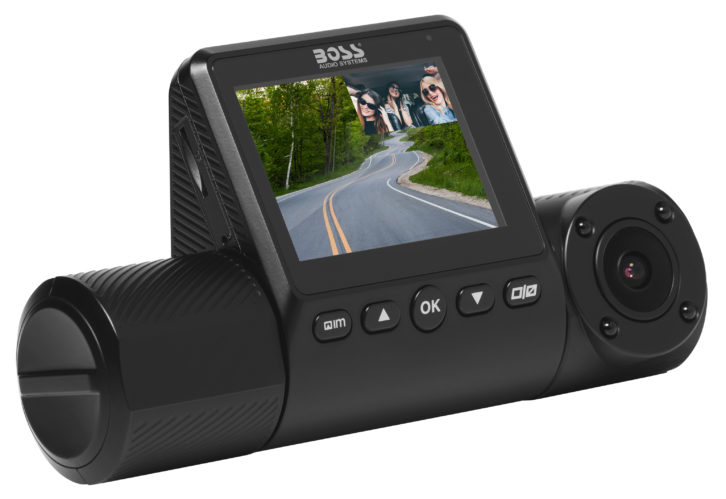
What is a Dash Cam?
Dash cams can be thought of as mobile portable doorbell cams – the two devices share a multitude of tech, specs, and usage/management commonalities. Always-on-the-move dash cams, however, require much higher precision, data capture, and intelligence than stationary doorbell cams.
A dash cam “operates in a constantly changing, high-speed, high-stakes environment,” explains Jeff Chuh, head of global marketing for U.K.-based Nextbase, which claims that sales of dash cams have increased by 350% in the past four years. “It must perform reliably while the vehicle is moving at highway speeds, navigating changing light conditions, weather, vibrations, and unpredictable motion. It needs to capture fast-moving objects in real time, often from challenging angles. There may be multiple vehicles, pedestrians, or obstacles entering and exiting the frame at once. There is no fixed network connection. Everything must be processed and stored locally, instantly, and securely.”
One major difference between dash cams and doorbell cams is how footage is recorded and stored. While doorbell cameras primarily record based on motion, dash cams capture video continuously whenever the car is running. Footage is recorded in a loop onto a local microSD card, usually in 1080p but increasingly in 4K, and sometimes simultaneously in both high resolution for detail and in low resolution as a compressed sub-10Mb clip for fast upload/download, or quick sharing via an app, email, or insurance forms.
 When the microSD card is filled, new footage is recorded over the old – except when the dash cam detects an “event,” such as when brakes are suddenly activated, when sudden movements are made, and, of course, in the case of collisions. Dash cams automatically save “events” and are not overwritten.
How much footage is ultimately stored depends, of course, on the capacity and quality of the microSD card. Footage can be transferred to a consumer’s home phone or PC via Bluetooth or Wi-Fi, and some dash cam makers also add on cloud storage.
“The critical factor for dash cam performance is write speed, which refers to how fast the card can reliably save large amounts of high-resolution video data in real time,” Chuh stresses. “If the write speed is too slow, the card can drop frames, corrupt files, or fail entirely, often without warning.”
Many dash cam models also include a parking mode that activates and records when motion is detected, as well as other emergency or special event modes that operate when the car isn’t running. Some dash cams add voice warnings about what’s happening around a driver, such as pedestrians in a walkway, too-close vehicles, or even when the car in front of you begins to move after a traffic light change.
Other top-line dash cam features include:
- Telematics, such as speed, time, location, and route information displayed when the dash cam is paired with a GPS module. Telematics and GPS data are integrated with the video footage and stored on the same microSD card.
- Field of Vision, or FOV, is usually more than 160 degrees, critical to capture full lane coverage and blind spots. If a dash cam’s FOV is too wide, footage can be distorted, and edge blur can occur.
- Night Vision, which is where most cheap dash cams disappoint. Dash cams should be equipped with large sensors, wider apertures, and advanced software to ensure optimal detail resolution in low or poor lighting conditions.
- Event Detectors/G-Sensors are more accurate at recording events if they’re supplemented by proximity sensors, radar, and even AI to better alert drivers in real time.
“It is not just about sticking a camera in a car,” Chuh emphasizes. “It is about creating a precision-tuned, high-performance imaging system that can read number plates at 70 miles per hour, see clearly at night, and detect incidents the moment they happen,” as well as identify faces.
Retail Dash Cam Opportunities
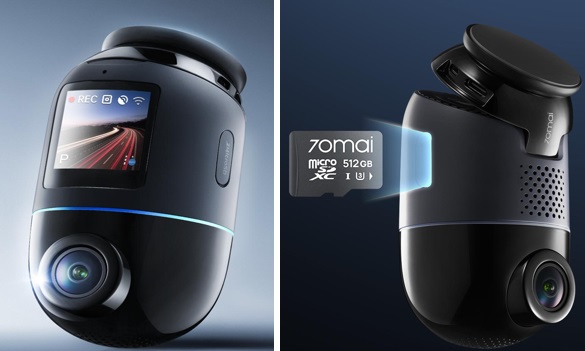 Most dash cams are sold online by brands most retailers wouldn’t recognize, such as Redtiger, Rove, and 70Mai, as well as more familiar names as Garmin and Nextbase. Many online no-name vendors sell cheap re-branded OEM products or devices slapped together from off-the-shelf parts that lack quality and reliability.
Many dash cam vendors don’t even bother selling at physical retail in the U.S., but that may be changing.
“Currently, we only have after-sales points, which are primarily focused on helping users install their products, and are still in the initial stage,” explains Annie Shao, director of sales and marketing for premium dash cam maker 70Mai. “Although we do not have a physical retail in the U.S., we have physical retail in Malaysia and plan to have an offline store in the US in the future.”
While dash cams are often bought inexpensively online, physical retailers can offer tangible benefits to potential but hesitant or confused customers.
“Retailers should understand that dash cams are not just gadgets or accessories,” Chuh insists. “They are part of a growing safety and protection category that delivers real value to drivers and passengers. Selling them is not about technical specs alone. It is about offering peace of mind, proof, and control in moments that matter most. That emotional value is something brick and mortar retailers are uniquely positioned to emphasize.”
Since driving is a 360-degree exercise, many dash cams are sold in multi-camera bundles. While the Autoinsurance.com survey found that 90% of installed dash cams face front – duh! – the survey discovered that 56% of dash cams face the rear, not a surprise since drivers also might want to prove that someone hit them from behind. Another 30% of dash cams sold are interior cameras addressing the need for ride share drivers to document rider misbehavior as well as to record police stops that could go sideways. Around 19% of cameras sold face the side, and 8% of buyers even mount a camera in the trunk.
Multi-camera bundles complicate DIY installation and add to the value of a purchase through a physical retailer.
“We see brick and mortar retail not just as a point of sale, but as a true extension of the customer experience,” Chuh adds. “Purchasing through brick-and-mortar retailers…comes with the option for professional installation, which ensures clean cable management, proper power configuration, and full peace of mind.”
But perhaps the biggest advantage of in-store retail dash cam sales, according to Chuh, “is the ability to understand the customer’s real problem and guide them toward the right solution.”
See also: 70mai Launches 4K Omni Dash Cam With Dual-Channel Recording