Ultra-efficient induction cooktops continue to gain ground against traditional gas and electric rivals. According to Grand View Research, the induction cooktop category represented $27.7 billion in revenue as of 2024. But one of the most exciting developments is that it also boasts a wholly unique niche compared to other cooktops: invisible induction cooktops.
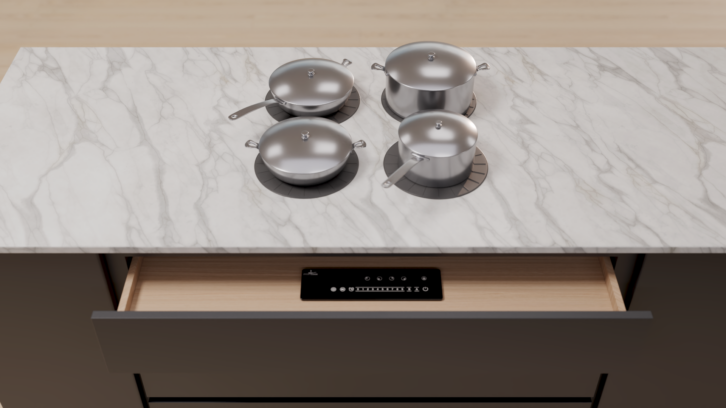
This premium product segment turns heads—or perhaps doesn’t, depending on your perspective—because it turns a countertop into a practical cooking surface. It allows kitchen designers and retailers to create minimalist kitchens with special abilities. Because the cooktop is part of the working surface, it functions as a normal countertop when not needed, making it especially suitable for installation in kitchen islands. Let’s dig into this interesting cooking tech to see what’s on offer and how retailers can leverage it in showrooms.
The current landscape for invisible cooktops

Invisible induction cooktops are hardly a recent innovation, with Barcelona-based TPB Tech selling products as early as 2012. Early on, it set the standard by crafting cooktops that seamlessly blend with custom countertops. It’s also worth noting that the TPB Tech Induction Hob comes in a few standard cooktop sizes, making it one of the few options that can replace existing cooktops without a remodel.
TPB Tech also introduced elevated cookware adapters that raise induction-ready cookware above the cooking surface to improve safety. This feature is common in the category, as it reduces contact and heat transfer between the pan and cooking surface, allowing it to stay cooler than traditional induction hobs. It’s a crucial tool for reducing the temperature of the cooktop, which has fewer ways to visibly indicate a hot surface.
While TPB Tech built its system from scratch, the ABK Stone, a countertop manufacturer based in Valencia, worked to create an invisible induction cooktop compatible with its countertops. The result is the Cooking Surface Prime.
Invisacook, based in Florida, is one of the newest and most notable brands on the market—TIME named it one of the best inventions of 2023. Perhaps the most appealing thing about Invisacook is its compatibility with any stone or porcelain countertop surface, which provides more variety than the exclusive suppliers for other brands. The main design consideration is the thickness of the countertop, with the company listing over two dozen countertop manufacturers with proven compatibility. Zynella Kitchen, a Canadian company, takes a similar approach to countertop compatibility.
Invisible induction cooktops may be a hard sell for retailers
 There are a few hurdles preventing wider adoption of invisible cooking surfaces, but none more so than their biggest benefit: invisibility. Unlike traditional cooktops and ranges, which often slot into standard kitchen configurations without any tools, invisible induction cooktops require compatible countertops and cabinetry—except the TPB Tech Induction Hob. For example, an incompatible countertop may prevent efficient electrical induction or may suffer damage.
Since most existing kitchens don’t meet these requirements, this narrows the potential customer base to remodels and new construction. Appliance retailers already offering kitchen remodel services won’t need to adapt as much to accommodate customers wanting invisible induction cooktops, while businesses primarily dealing in standard cooking appliances may choose to skip the product segment.
Similarly, retailers must consider price communication strategies that go beyond the cost of the induction cooking hardware. This is because potential customers need to understand that overall upgrade cost also depends on the countertop, cabinetry, labor, and other installation factors.
Although individualized project quotes ultimately help clients decide whether to commit to a remodel, pricing communication should always start on the showroom floor through numerous estimates and a portfolio of work completed for past clients. With a little legwork, you can prepare a few examples of how your business approaches invisible induction cooktops for different budgets. Customers should expect a long lead time when ordering from most invisible cooktop brands. The main reason is the custom nature of the countertops.
The last major hurdle for invisible cooking surfaces is how retailers approach safety. While traditional cooktops often have a visual indicator to show when a surface is hot, such as a display or indicator light, invisible induction cooktops may only show this information on the control panel. It’s less of an issue in settings where the controls are always visible, but teaching customers to keep hideable control panels out until the surface cools is something worth considering. Likewise, you can work with your countertop supplier to etch a subtle outline of each burner or the general cooking area to provide a visual reference for safety and ease of use.
Naturally, a business choosing to become a dealer for a brand like Invisacook or TPB Tech will receive marketing and training resources along these lines. Still, it helps to know what to expect from the category at large.
See also: Copper’s Charlie Could Change Induction Cooking Forever