
TWICE wishes Gary Shapiro a very happy birthday!
A young Washington, D.C. attorney at the law firm of Squire, Sanders and Dempsey found himself walking the floor of the 1981 Summer CES in Chicago and had an epiphany.
“I thought that this was the most exciting event in the world,” Gary Shapiro later recalled. “I said to myself, ‘I want to be part of this. How can I?’”
When an offer came Shapiro’s way to join the Electronics Industries Association’s Consumer Electronics Group (EIA/CEG) – the forerunner of today’s CTA – his mentor at the firm, J. Edward Day, who had served as Postmaster General under President Kennedy, urged him not to take it.
“People who work for associations go there to retire or die,” Day warned.
Shapiro took the job anyway.
Over the next four-plus decades, Shapiro would transform not only CTA but the entire consumer technology industry, and turn CES into the most well-known, well-covered, and influential trade show on earth.
On May 1, 2026, Shapiro transitioned to the role of Executive Chair of CTA, with Kinsey Fabrizio succeeding him as President and CEO. In the letter he sent to colleagues announcing the change, he quoted Kenny Rogers: “Know when to hold them. Know when to fold them. Know when to walk away. Know when to run.”
Shapiro sure knows how to walk (CES) and how to run (CTA).
I Am Born
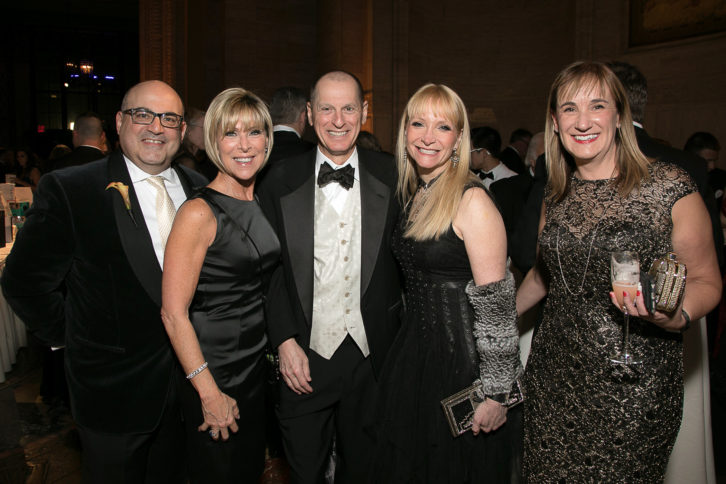 From left: Technologist Shelly Palmer and his wife Debbie, Consumer Technology Association (CTA)’s Gary Shapiro and wife Dr. Susan Malinowski, and CTA’s Jean Foster.
Gary Shapiro was born on August 28, 1956, in Wantagh, Long Island, New York, to Jerome Shapiro, an elementary school teacher and principal, and Mildred Shapiro, a Canadian-born Hebrew school teacher who also sold World Book Encyclopedia. Growing up, Shapiro was captivated by Perry Mason and decided early he wanted to go to law school – not as a means to an end, but out of genuine love of learning, a value instilled by his mother. He was, in his own telling, one of the rare law students who actually loved the experience.
Shapiro describes growing up with three brothers and limited money, working early – from family piecework to mowing lawns and restaurant jobs. He experienced an unmistakable turning point at 15 after a day of repetitive factory work: “Dad, I’m going to college.”
An early tinkerer and audiophile, Shapiro assembled a serious hi-fi system in high school – Dynaco A25 speakers, a BSR turntable, and a Pioneer amp.
During his undergrad years at SUNY Binghamton, Shapiro worked as a house manager running concerts and live events, setting up Peavey sound systems, placing mics and speakers for late-night performances by the Hispanic Student Union and Black Student Union.
After graduating from Binghamton Phi Beta Kappa with a double major in economics and psychology, he earned his J.D. at Georgetown University Law. He then served as an assistant to Rep. Mickey Edwards (R-OK) before joining Squire Sanders.
The Betamax Crucible
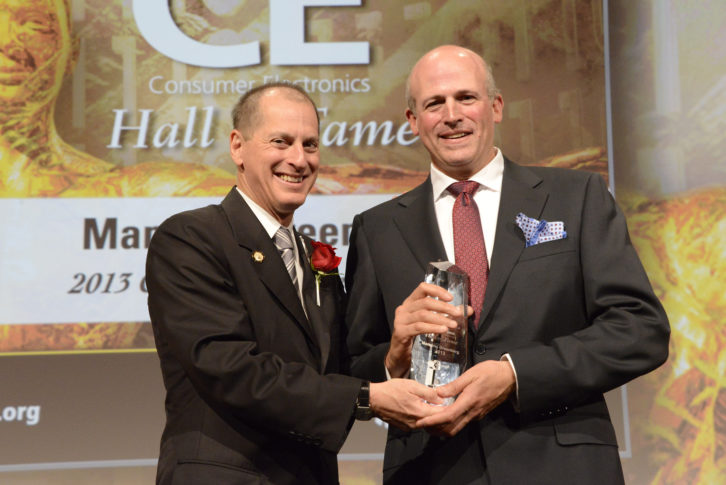
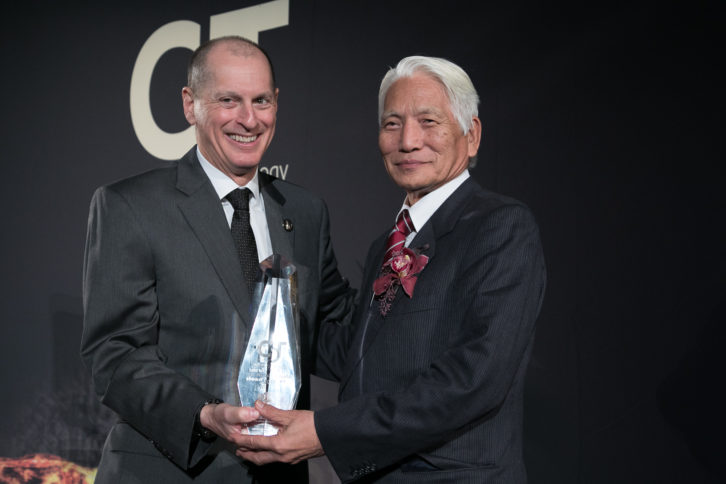 MPEG member Hiroshi Yasuda accepts the Hall of Fame honors from CTA’s Gary Shapiro on behalf of his team.
Shapiro began working on EIA/CEG matters while still in law school, eventually devoting nearly his entire time there to the client, which continued when he joined Squire Sanders full-time.
One of Shapiro’s most consequential early assignments – and perhaps the most consequential technology decision in American history – was helping prepare the Sony Betamax case. Officially Sony Corp. of America v. Universal City Studios, the case went to the U.S. Supreme Court and established that taping television programs for time-shifting was fair use, not copyright infringement, igniting the entire home video revolution.
Shapiro observed how the Sony Betamax decision and the broader fair-use principle reinforced the long game: keep consumer technologies legal, win the public argument, and let falling prices and rising adoption make the politics inevitable.
The Betamax case also helped Shapiro realize the importance of organizing retailers as allies. “You needed consumers, real people,” he explained, to communicate the value of the VCR to Congress. He later generalized the same insight to subsequent tech fights: you can’t make illegal what people come to love, and a lobbying philosophy: policy wins require human messengers, not just white papers.
More importantly, Shapiro heeded the Betamax case post-mortem from his mentor, long-time Cobra president and CEO Jerry Kalov: “Gary, you saved VCRs. Now save the association!”
Joining and Raising the Industry

Although he had been working closely with the organization for at least a year prior, Shapiro formally joined EIA/CEG on October 4, 1982 – hired as general counsel by Jack Wayman, the legendary industry leader, cheerleader, and showman who had originated and built CES into the consumer electronics business’ signature event.
When Wayman brought Shapiro aboard, colleagues noted that the young attorney had an unusual quality: he was genuinely excited by the products. Where other legal counsel treated the consumer electronics industry as a client to be managed, Shapiro treated it as a cause to be championed.
Wayman, himself a born promoter who understood the power of enthusiasm, immediately recognized a kindred and passionate spirit. He gave Shapiro unusual latitude for someone his age and seniority, assigning him to government affairs battles that would have typically gone to more seasoned hands. Wayman reportedly told an EIA/CEG colleague that the young attorney would “save you money, and one day he’s going to take your place.” It was one of the more prescient assessments in the history of the consumer technology business.
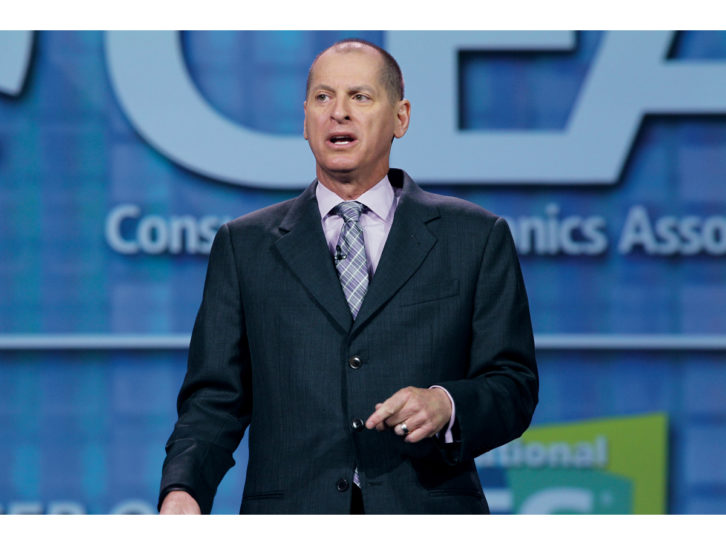 When he joined the organization, CEG was comprised of roughly 60 to 70 members and was still, in Shapiro’s own description, “a big boys club” and still part of EIA.
Shapiro rose steadily through the EIA/CEG ranks, from general counsel to VP of Government and Legal Affairs. In July 1990, he was named Group Vice President of EIA CEG, and, in July 1991, was put fully in charge of what would eventually become CTA.
Kalov was Shapiro’s most important professional influence, and offered a line Shapiro has quoted more than once: “You’re doing a great job, but when you make some mistakes, and you will, I’ll be there for you.” Kalov served as a buffer during board fights, and counseled Shapiro that the board would support his ambitions to open the association to new technologies and smaller companies.
And they did. By the time Shapiro stepped back from day-to-day leadership last week, CTA membership had grown to more than 1,000 companies, encompassing not just traditional CE manufacturers but retailers, entrepreneurs, distributors, and content providers from virtually every sector of the technology world.
Policy and Legislative Successes
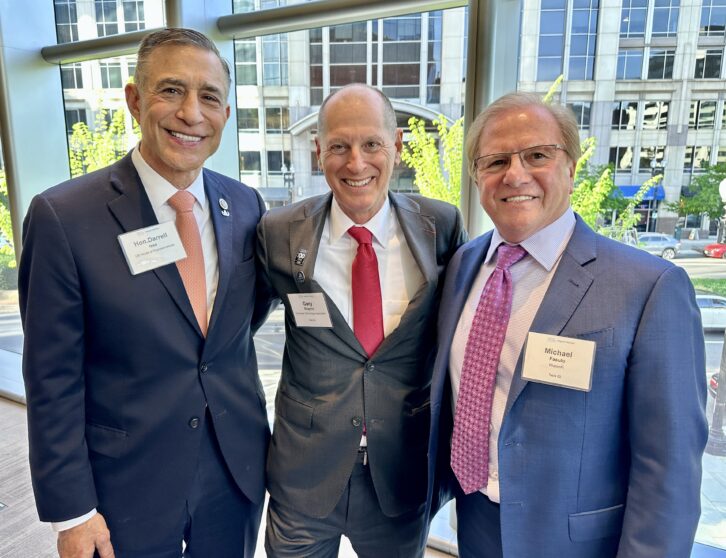
Under Shapiro’s leadership, CTA became one of the most effective technology advocacy organizations in the world. The list of legislative and policy battles Shapiro waged – and won – is remarkable in its breadth.
He protected consumers’ home recording and video rental rights when Hollywood was determined to eliminate both.
He championed the development and adoption of HDTV, shepherding the technology through government regulatory roadblocks and into American living rooms.
He helped create Virginia’s legal framework for Internet commerce, which became a global model.
He was instrumental in establishing “airplane mode” as a standard feature on mobile devices.
He pushed successfully for hearing aids to be sold over the counter at retail like eyeglasses, a consumer access reform that took years of sustained effort.
He battled and beat SOPA and PIPA, legislation that threatened the open internet.
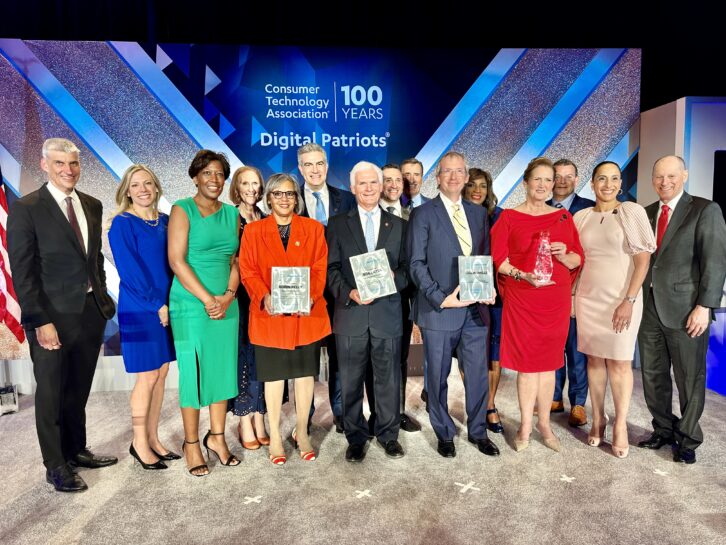
(Image Credit: Stewart Wolpin)
And he consistently fought to ensure that access to technology was recognized as a fundamental right. His advocacy was ultimately affirmed when the United Nations added technology access to its list of basic human securities.
Perhaps most importantly, Shapiro gradually weaned the organization from being a part of EIA and, through name changes from the EIA’s CEG to CEMA (1995), to CEA (1999) as an independent sector within EIA until that overarching organization’s dissolution in 2011 and independence, and finally, in 2015, to CTA to better reflect the group’s ever-widening technology portfolio.
CES Growth
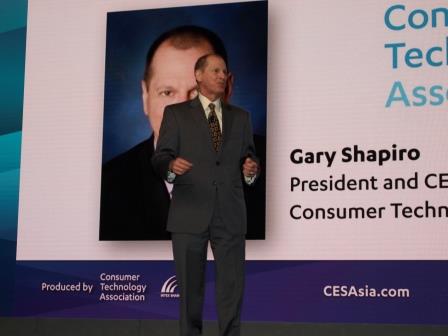 CES also became something altogether different under Shapiro’s stewardship. When he assumed control, CES was a modest industry-insider affair.
Shapiro methodically repositioned the January Las Vegas and June Chicago events, bringing in marquee keynote speakers, cultivating the financial press and international media, attracting government leaders from around the world, – essentially, transforming the show from a static retail buying event into an adaptive platform. Shapiro also invested heavily in the show’s infrastructure rather than merely extracting profit from it.
Shapiro also made the painful but ultimately correct call to consolidate CES into a single annual show in Las Vegas, consolidating CES into “one mega show” in Las Vegas.
However, the loss of Summer CES to the video game industry remains one of the most discussed strategic inflection points of Shapiro’s tenure. In a 2002 interview, he was notably unguarded about it: “We lost Summer CES to E3. It wasn’t something they gained. It was something we lost. I disagreed with the board on how we approached the video game industry. Someone said they would come back to us on our knees. I fought and lost on that one.”
 CTA president/CEO Gary Shapiro and Hisense chairman Zhou Houjian
Now with a single CES to focus on, Shapiro actively redefined what counted as consumer technology, going after Hollywood, Wall Street, automotive, and healthcare as the retail universe itself fragmented and the center of gravity within the industry continued to shift.
Shapiro navigated CES through the Y2K scare, the 2008 Great Recession, expanding its reach to attract exhibitors from more than 150 countries and pushing attendance past 180,000.
In 2012, Shapiro opened Eureka Park as a dedicated launchpad for startups and entrepreneurs to showcase new technologies, and it now hosts more than 1,000 entrepreneurs. Eureka Park alumni have collectively raised more than $1.5 billion in funding, and helped spawn companies such as Indiegogo, Impossible Foods, Withings, BenjiLock, and Doorbot – now known as Ring.

In early 2020, just weeks after CES wrapped, Shapiro’s wife, Dr. Susan Malinowski, a retina surgeon, heard a brief radio story about a full-city quarantine in China. She warned her husband that this virus was going to infect the world.
While the rest of the trade show industry spent the spring of 2020 in denial, Shapiro listened to his wife. To the absolute consternation of his trade show peers, he announced a pivot to an all-digital CES a full seven months before the 2021 show. Behind the scenes, he admitted the decision cost CTA millions of dollars and was terrifying to make, but he lived by a rule he later codified in one of his books: “Make hard decisions early, stay true to your values, and adapt before it is too late.”
By any independent measure, Shapiro morphed CES to become the world’s premier technology trade show – not only for consumer tech but all tech, including AI, quantum computing, AR/VR, boating, agriculture, smart health, and an auto showcase now larger and more influential than the Detroit Auto Show. In short, under Shapiro’s leadership CES is now where the global technology agenda is set each January.

CES became so big under Shapiro that he once logged 105,000 steps – 46 miles – walking the show and turned “walking endurance” into a recurring motif of how he experiences the show. Shapiro once joked the show needed exhibit space for his shoe collection, a “million square shoes.”
Colleagues note that Shapiro, for all his competitive instincts, was unusually willing to own his imperfections publicly.
For instance, in 1995, he recounted advising Microsoft’s CEO Bill Gates on a CES intro and – mortifyingly – declaring it one of the greatest product intros ever. Except the so-called “friendly” PC software interface became “one of the most annoying things” and an infamous tech fail, Microsoft Bob.
During a 2023 backstage interview at CES with a younger digital media creator, Shapiro enthusiastically praised the creator’s energy, laughing and saying, “You are like everything I’m not. You are cool and younger, and you use cool words!” It was a small moment, but it highlighted Shapiro’s willingness to drop his “CEO shield” and simply be a fan of the people covering his show.
But Shapiro turned his self-deprecation into a management philosophy: great organizations institutionalize dissent and diversity of thought, so no one is afraid to tell the leader “this is a bad idea.”
Running CTA
Shapiro also was a pioneer in how CTA ran as an organization.
It was among the first nonprofits to introduce incentive compensation for all employees.
It launched wellness programs, contributed monthly to employees’ student loan payments, and offered grants to help employees purchase homes.
The organization received consistent recognition as one of the Washington area’s best employers.
Shapiro championed diversity long before it became a corporate buzzword, actively recruiting diverse CTA leaders and CES speakers, and creating the Innovation for All program to channel venture capital toward entrepreneurs – women, people of color, people with disabilities, and veterans – who were being overlooked by traditional financing.
The CTA Foundation he helped create funds technology programs empowering seniors and people with disabilities.
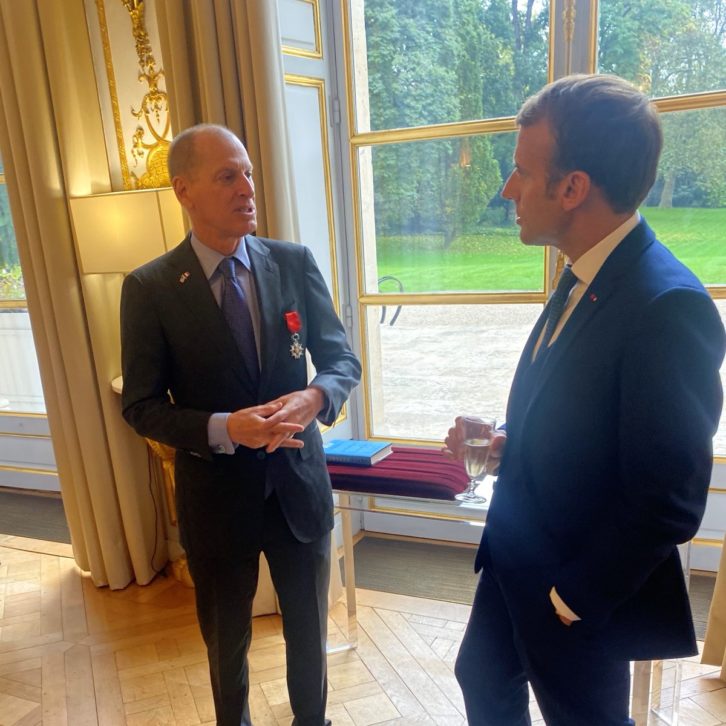
Shapiro’s influence extended well beyond the trade association world. A prolific author and speaker, he has written four books and produced more than 1,500 opinion pieces over his career. He received the Media Institute’s prestigious Freedom of Speech Award. He was knighted by the Royal Order of Francis I. In recognition of his work promoting technology and innovation on the international stage, he was received at the Élysée Palace and awarded the rank of Chevalier and the Légion d’Honneur by French President Emmanuel Macron.
As CTA’s newly minted executive chair, Shapiro likely will remain a highly visible and influential figure within CTA, the varying technology industries CTA now encompasses, and in Washington, likely to the benefit of all concerned.