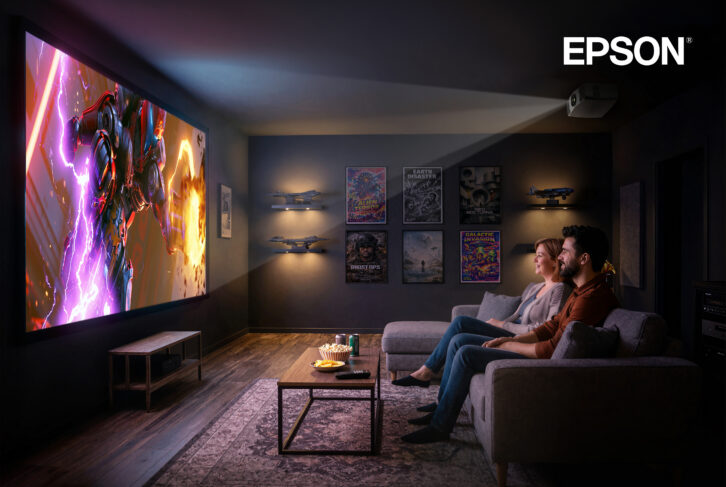
 With 98-, 100-inch and larger TVs becoming an increasingly important part of the premium home entertainment market, Epson used CEDIA Expo 2026 to make the case that projection still has some significant advantages, particularly when consumers want to go really big.
At the Denver show, Epson showcased its Q-Series home projectors across several installations designed to demonstrate two distinct opportunities for custom integrators: delivering cinematic images at sizes that remain difficult for conventional TVs to match, and bringing large-screen entertainment into design-conscious living spaces where homeowners may not want a massive display permanently occupying the wall.
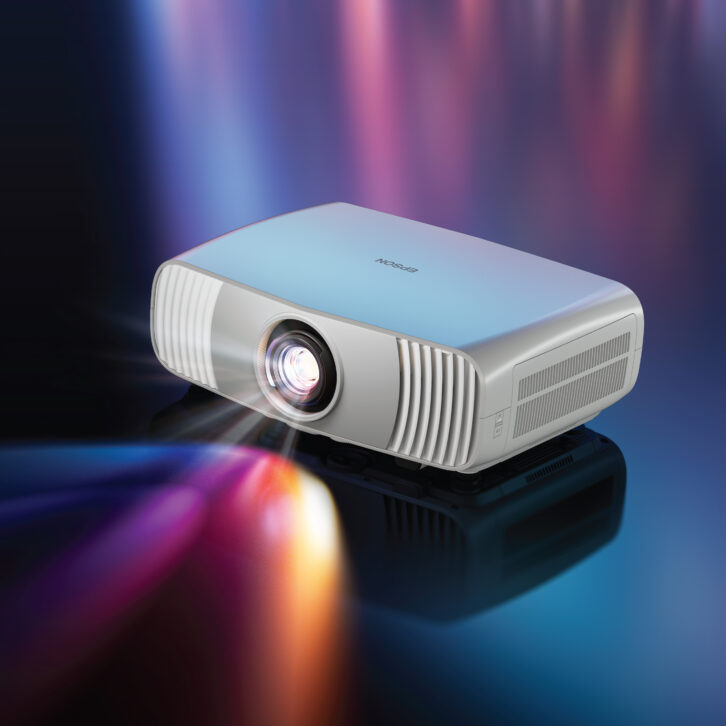
At the center of those demonstrations was Epson’s 10,000-lumen QL7000 4K 3LCD laser projector, which the company paired with screens ranging from 135 inches to a massive 215 inches.
“Advancements in projection technology are giving integrators more options for delivering compelling large-screen entertainment in spaces that may have traditionally been challenging for projection,” said Melvin Diaz, senior product manager, home entertainment, Epson America.
Diaz said the Q-Series’ combination of high brightness, image performance and compact form factors was intended to bring immersive cinema experiences into a broader range of rooms.
For dealers and integrators, that broader-room proposition could prove particularly important as the competitive landscape for projection continues to change.
Going Where Giant TVs Can’t Easily Follow
The premium large-screen TV market has changed considerably in recent years. Screen sizes that were once specialty products have moved closer to the mainstream, providing consumers with increasingly practical direct-view alternatives to projection.
That puts additional pressure on projector manufacturers to demonstrate where projection continues to differentiate itself.
Epson’s CEDIA showcase offered one straightforward answer: scale that elegantly disappears.
The company paired its QL7000 with Stewart Filmscreen’s Director’s Choice Generation 2 four-way masking screen to create a 215-inch, 2.0:1 cinematic display.
The installation demonstrated how high-brightness projection can be used to deliver an image substantially larger than even the biggest conventional consumer televisions.
The 2.0:1 screen configuration also reflected the amount of streaming programming being produced in that cinematic aspect ratio.
Using Stewart Filmscreen’s StudioTek 130 G4 acoustically transparent screen material allowed the front left, center, and right speakers to be positioned behind the image, maintaining speaker localization while eliminating the need to place visible speakers around the screen.
For integrators, it highlighted one of projection’s clearest differentiators. At 100 inches, consumers now have a growing number of direct-view choices. At 150, 180 or more than 200 inches, the economics and practical considerations of the installation become a very different proposition.
 Making a Giant Screen Disappear
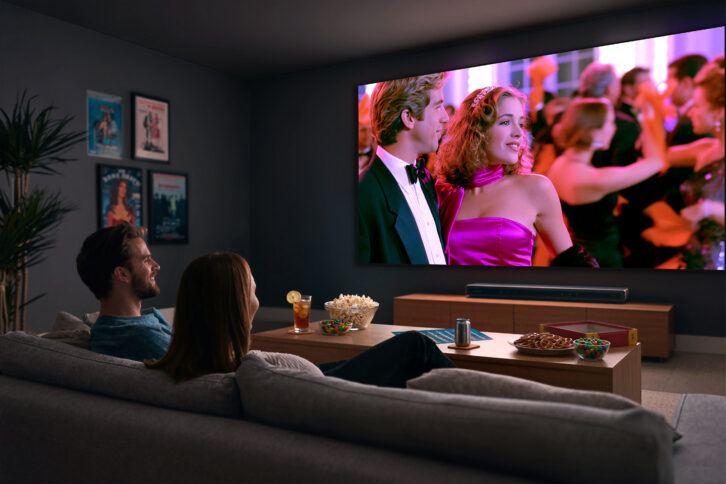
Epson’s other CEDIA installations addressed an arguably more complicated challenge: putting projection into rooms that aren’t dedicated home theaters.
The company demonstrated the QL7000 with a 160-inch Stewart Filmscreen Balón Edge Phantom HALR+ ambient-light-rejecting screen.
The acoustically transparent screen allowed speakers to be installed behind the image, while the Phantom HALR+ material was designed to maintain contrast in environments with controlled ambient light.
Another installation took the disappearing-display concept further.
Epson paired the QL7000 with its ELPLX02S short-throw lens and a 135-inch Stewart Filmscreen Luxus G2 Electric Roller Screen using GrayMatte 70 material.
The projector was integrated into the ceiling so that only its lens remained visible, while the screen retracted when it wasn’t being used.
That approach potentially gives integrators another way to compete with increasingly large direct-view displays.
A 100-inch-plus television can deliver an impressive image, but it remains a 100-inch-plus physical presence on the wall when it is switched off. A concealed projection system can largely return the room to its original appearance once the screen retracts.
For integrators working alongside architects and interior designers, that difference could become an increasingly valuable part of the projection sales pitch.
Brightness Expands the Conversation
Ambient light has historically been one of projection’s biggest limitations outside a dedicated theater, which helps explain Epson’s emphasis on brightness with the Q-Series.
The QL7000 delivers up to 10,000 lumens of color and white brightness, according to Epson, using the company’s 3-chip 3LCD architecture and 32-bit QZX picture processor.
That level of output gives integrators more flexibility when designing very large images and working in rooms that aren’t completely dark, particularly when paired with an appropriate screen.
It doesn’t erase the inherent differences between projected and direct-view images. But the combination of brighter projectors and specialized screen materials can broaden the range of residential spaces where projection becomes a realistic option.
That also creates a potentially larger sale for the custom channel.
A premium projection installation can encompass the projector, lens, specialized screen, architectural integration, audio, lighting, and control rather than simply the display itself.
 The Q-Series Custom-Install Play
Epson introduced the Q-Series in 2024 with three models aimed at premium home entertainment and custom installation: the 3,300-lumen QB1000, 6,000-lumen QL3000 and 10,000-lumen QL7000.
The QL3000 and QL7000 are offered without lenses, allowing integrators to choose among Epson’s compatible lenses based on throw distance, room dimensions and architectural requirements.
The flagship QL7000 supports images up to 300 inches, according to Epson, along with signals up to 4K/120Hz. The company specifies a laser light-source life of up to 20,000 hours.
Projection Finds a Different Battleground
Perhaps the most interesting takeaway from Epson’s CEDIA presentation was not simply that projectors are getting brighter.
It was that Epson appeared to be positioning projection as the market for very large TVs continues to expand.
Competing head-on with a large direct-view display in every room is becoming a tougher proposition as TV sizes increase and prices decline. Instead, Epson’s demonstrations emphasized two areas where projection can offer integrators something different.
One is sheer scale. The other is invisibility.
“From dedicated home theaters designed for large cinematic experiences to beautiful living spaces with more ambient light, the Q-Series gives integrators the flexibility to create an extraordinary viewing experience while allowing the technology to elegantly disappear into the space,” Diaz said.
For the custom channel, that may increasingly define projection’s role in the era of giant TVs: go significantly bigger than the television – or disappear when the television can’t.
See also: BenQ Adds AK900ST And AK800ST 4K Golf Sim Projectors