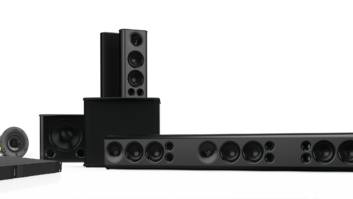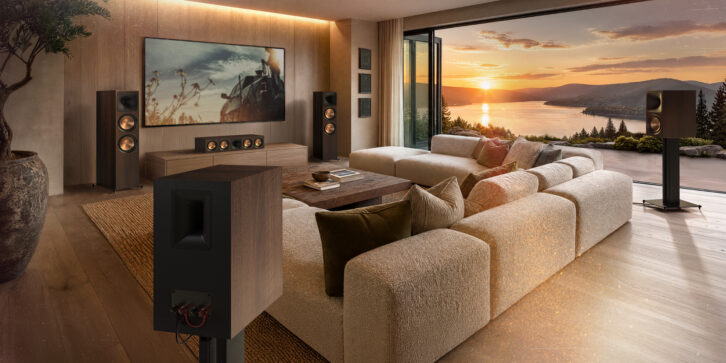
Klipsch came to CEDIA Expo 2026 with more than a collection of new speakers. Celebrating its 80th anniversary, the company showed how it is expanding its premium audio portfolio at both ends of the market — pushing upward with the new Reference Signature Series while giving consumers more flexible ways to enter the Reference Premiere ecosystem.
At the center of the CEDIA story was the all-new Reference Signature Series, which attendees had the first opportunity to hear ahead of its global launch this winter. Klipsch first previewed the speakers during its 80th-anniversary “Backstage Access” presentation at CES 2026, but invitation-only demonstrations at CEDIA provided the first listen to the new architecture.
“Following the strong response to the new design when we previewed it at CES, it’s extremely gratifying to now demonstrate the powerful sound of this series,” said Andy Spalla, director of product management for Klipsch. “As we continue to celebrate our 80th year, there’s a tremendous sense of pride across our team, and each new product we introduce is an opportunity to honor that legacy while giving even more music and movie fans a reason to consider Klipsch.”
Reference Signature consists of six models: the RS-8301F and RS-6301F floorstanding speakers, RS-8301M and RS-6301M monitors, RS-6301C center channel and RS-6101SA Dolby Atmos surround/height module.
The bigger story, however, is what’s happening inside the cabinets. The floorstanding, monitor and center-channel models use dedicated high-frequency, midrange and low-frequency drivers, bringing a true three-way architecture to the series. Klipsch says the approach allows each driver to concentrate on the frequencies it was engineered to reproduce while moving crossover points outside the ear’s most sensitive band.
Reference Signature also introduces a phase-aligned horn design that positions the midrange directly within the tweeter horn, allowing the two to radiate from the same acoustic center. According to Klipsch, the design improves coherence through the crossover region and provides more consistent tonal balance across a wider listening area.
The RS-6301C center channel takes a similarly purposeful approach, using a vertical driver array designed to reduce the horizontal lobing and comb filtering associated with conventional MTM layouts. The goal is clearer dialogue and more consistent timbre across multiple seating positions. The RS-6101SA, meanwhile, can serve as a Dolby Atmos elevation speaker, height channel or rear surround, with a switchable crossover for Atmos and Surround modes.
Klipsch has paired the acoustic changes with a more elevated industrial design. Ebony and Walnut finishes feature horizontal grain patterns that follow the curved cabinet form, while a leather top panel adds a furniture-grade detail. Select models also offer adjustable tweeter levels of +1dB, 0dB and -1dB along with dual binding posts for bi-wire and bi-amp configurations. Target pricing ranges from $1,600 to $3,000 per pair, with final pricing and complete specifications expected at launch.
Expanding Reference Premiere
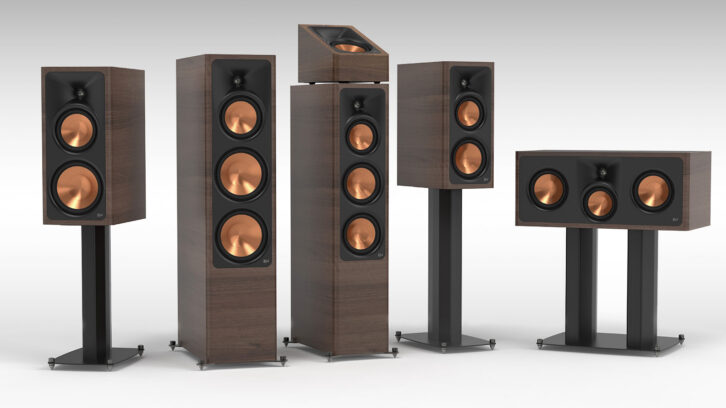
Alongside Reference Signature, Klipsch showed how it is broadening the reach and flexibility of its Reference Premiere family.
The new Reference Premiere III Series, which made its global debut at Audio Advice Live in August, offers nine models spanning floorstanding, bookshelf, center-channel and surround speakers. The lineup accommodates everything from two-channel music systems to immersive home theaters, including the RP-8263FA floorstander with integrated Dolby Atmos height drivers and the RP-5103SA, which can be used as an Atmos elevation speaker or wall-mounted surround.
Reference Premiere III introduces a high-density axial Tractrix horn tweeter with upgraded BMC material designed to reduce resonance. The horn is flush-mounted to minimize wave breakup and improve off-axis response for a wider listening area, while Klipsch’s signature copper Cerametallic woofers handle the lower frequencies. New metal outrigger feet on the floorstanding models are designed to further isolate the cabinet and tighten response.
For dealers and integrators, the series also pairs with compatible Onkyo A/V receivers through Klipsch Optimized Mode, which automatically applies crossover settings designed for select speaker models to simplify system setup.
Klipsch is extending that flexibility to the low end with three Reference Premiere Compact Subwoofers, addressing one of the practical challenges of bringing serious bass into living spaces where a large enclosure may be difficult to accommodate.
The RP-1200CSW, RP-1400CSW and RP-1600CSW use 12-, 14- and 16-inch high-excursion Cerametallic woofers in sealed enclosures that Klipsch says occupy roughly half the footprint of its full-size Reference Premiere subwoofers. Each combines Class D amplification with an analog preamp and offers adjustable crossover, phase and gain controls. RCA/LFE inputs and compatibility with the optional WA-2 Wireless Subwoofer Kit give installers additional placement flexibility.
The flagship RP-1600CSW demonstrates that Klipsch isn’t using “compact” as shorthand for modest performance. The 16-inch model is rated down to 14.5Hz ±3dB, with maximum acoustic output of 123dB and 800 watts RMS/1,600 watts peak amplification. It carries a $1,499.99 MSRP. The RP-1400CSW is priced at $1,099.99 and the RP-1200CSW at $849.99, with all three scheduled for November availability.
Perhaps the clearest indication that Klipsch wants to extend Reference Premiere to a broader audience, however, is one of the smallest products it brought to CEDIA.

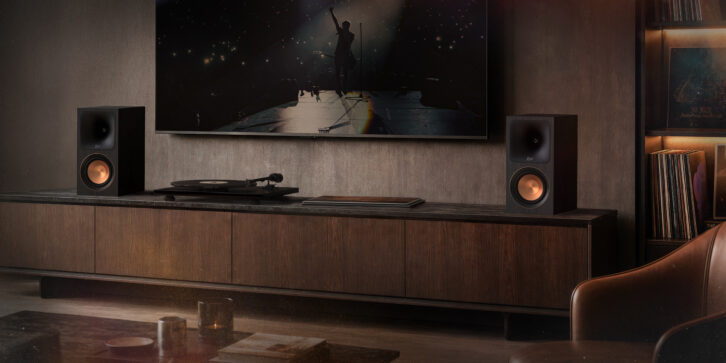
The RP-500PM Powered Monitor, making its global debut at the show, is the first powered monitor in the Reference Premiere Series. Its built-in amplification eliminates the need for an external amplifier or A/V receiver, giving consumers a more straightforward route into a higher-performance stereo system.
That simplicity carries through to connectivity. HDMI ARC lets the RP-500PM connect directly to a TV, while Bluetooth 5.3, USB-C, optical, RCA line-level, phono and 3.5mm inputs support sources ranging from turntables and computers to gaming consoles and mobile devices. A dedicated subwoofer output provides a simple upgrade path to a 2.1 system.
The RP-500PM retains the acoustic and visual cues of the larger Reference Premiere family, pairing the new high-density axial Tractrix horn tweeter with a 5.25-inch Cerametallic woofer and Klipsch’s familiar black-and-copper styling. Priced at $799.99, the powered monitors are scheduled to arrive in North America in December.
Taken together, Klipsch’s CEDIA lineup shows a company using its 80th anniversary not simply to celebrate its past, but to widen the ways consumers can experience the brand.
Reference Signature gives dealers and integrators a new step-up loudspeaker platform, while Reference Premiere III provides the building blocks for systems ranging from two-channel listening to immersive Dolby Atmos theaters. The compact subwoofers bring high-output bass to installations where space is at a premium, and the RP-500PM removes much of the complexity traditionally associated with component audio.
For the channel, that breadth may be the most significant part of Klipsch’s CEDIA story. Rather than offering a single vision of what a premium audio system should be, Klipsch is giving dealers and integrators more ways to bring high-performance sound into the rooms — and lifestyles — of today’s consumers.
For more information, go to www.klipsch.com.