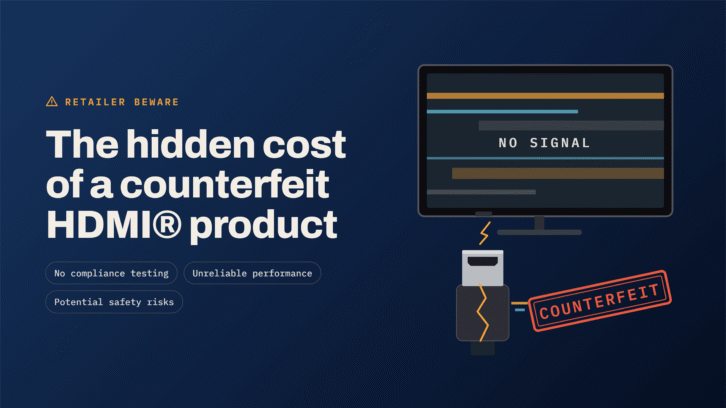
The global popularity of HDMI® technology has made it the standard connection for nearly every TV, monitor, gaming console, set-top box, and computer sold today. That same popularity has made HDMI products a target for counterfeiters. For retailers, the danger goes well beyond a disappointed customer or a returned cable. Stocking unlicensed or counterfeit HDMI products can expose a retailer to regulatory fines, lawsuits, recall expenses, and lasting brand damage.
The good news is that retailers have well-established tools to protect themselves and to hold suppliers accountable when non-compliant goods slip into the supply chain.
Retailers Have Leverage, and They Use It
When a manufacturer delivers goods that violate licensing, compliance, safety, materials, or environmental regulations, the retailer is often the first party exposed. That is why most retail relationships are governed by a vendor agreement or vendor code of conduct, in which the supplier warrants that every product complies with applicable laws such as the Consumer Product Safety Act, RoHS, REACH, and California’s Proposition 65, as well as 3rd party compliance requirements.
Contractual Penalties
When a product fails to meet those obligations, vendor compliance policies give the retailer several immediate remedies:
- Chargebacks and offsets. The retailer can deduct penalties directly from the amount it owes the supplier for inventory.
- Administrative fees. Flat per-violation fees cover the cost of identifying, documenting, and handling non-compliant goods.
- Refused deliveries. Shipments can be rejected at the distribution center, leaving the supplier to pay for return freight or disposal.
Legal and Financial Indemnification
Standard retail contracts also contain indemnification clauses. If a government agency or company fines the retailer, or a consumer sues over a hazardous or non-compliant product, the supplier is typically obligated to cover legal defense fees and court costs, pay the fines on the retailer’s behalf, and absorb the cost of any settlements or judgments.
Recall Costs
If a product must be recalled, retailers generally pass the full cost back to the supplier. That includes the inventory itself, the logistics of pulling items from shelves and warehouses, customer notification and recall registry management, and the safe disposal of hazardous materials.
But these protections are only as strong as the supplier standing behind them. A legitimate, licensed manufacturer has a reputation, assets, and a business relationship to protect. A counterfeit supplier often does not, and may simply disappear when the chargebacks, lawsuits, or recall notices arrive. That leaves the retailer absorbing costs it expected someone else to cover. The safest strategy is to avoid the problem at the source.
One Device, Thousands of Licensed Technologies
It’s easy to think of an HDMI port as a simple connector, but it is one of many licensed technologies inside many types of electronic devices. Consider a desktop computer: a single system can draw on thousands of patents and other IP, most of which the manufacturer does not own and must license through agreements, patent pools and standard-essential patent (SEP) arrangements. These technologies span five broad areas:
- Connectivity and I/O standards: HDMI® technology, DisplayPort™, USB, PCI Express®, Wi-Fi, Bluetooth® and Ethernet
- Compute architecture and silicon: processor architectures, memory interfaces and storage interfaces
- Audio and video technologies: video codecs such as H.264 and HEVC, and audio formats such as Dolby® and DTS®
- Power, manufacturing and components: power delivery standards, cooling designs and PCB fabrication methods
- Security and firmware: UEFI/BIOS code and hardware security such as TPM 2.0
Many of these technologies require not just a license but compliance testing and certification. Legitimate manufacturers invest heavily to secure those rights and prove their products meet the specifications. Counterfeiters skip these steps, which is exactly why their products are risky.
Additional Reasons to Only Purchase and Use Licensed HDMI® Products
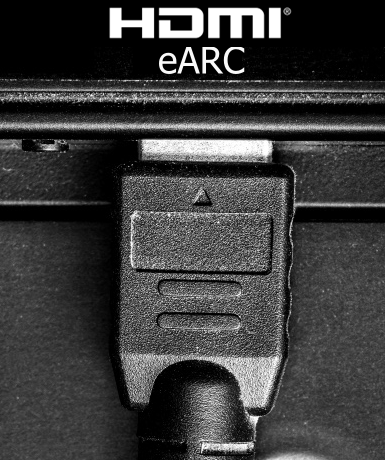
Beyond contractual and legal exposure, there are practical reasons why every link in the consumer electronics chain, from manufacturers and distributors to retailers and installers, should insist on genuine HDMI products. Even content creators, production facilities, and streaming and cable service providers can be affected when counterfeits degrade the viewing experience.
- Proper implementation. Building HDMI products requires compliance with current HDMI Specifications. Counterfeiters lack access to these specifications and often lack the technical expertise to manufacture complex systems, resulting in poor performance and problems for end users.
- Testing and certification. Genuine HDMI products go through rigorous testing and certification at HDMI Authorized Test Centers (ATCs). Purchasing certified products helps guarantee quality and reliability, and retailers and merchants can ask to see the official HDMI ATC Certificate as proof of compliance testing for their products.
- Preventing unnecessary returns. Counterfeits can be hard to spot. When performance problems in an installed system are mistakenly blamed on genuine products, or the counterfeit itself is identified, the result is unnecessary returns and frustrated customers.
- Warranties and support. Counterfeit products rarely come with warranties or support, leaving consumers, and the retailers who sold to them, with nowhere to turn when products fail.
- Long-term cost savings. A counterfeit may look cheaper up front, but frequent failures drive up replacement and service costs. Total cost of ownership favors genuine products.
- Safety and reliability. Counterfeiters often cut corners on materials and safety standards. Using authentic HDMI products helps avoid potential hazards and protects a reputation for reliability and potential consumer legal actions.
By insisting on genuine products and reporting suspected counterfeits, retailers protect their customers, their margins, and their reputation. Suspected counterfeit products can be reported anonymously at www.hdmi.org/resource/infringe
For more information, visit www.hdmi.org.
The terms HDMI, HDMI High-Definition Multimedia Interface, HDMI Trade Dress and the HDMI Logos are trademarks or registered trademarks of HDMI Licensing Administrator, Inc. All other trademarks, registered trademarks, or service marks are the property of their respective owners in the United States and/or other countries.