When I saw Apple was having a new product reveal centered on my beat, home and video products, rather than another big whizz-bang event on phones, tablets, and Macs, I thought, “Finally! AT LAST!” It got me thinking of Etta James’s great 1960 rendition of a 1941 song by Mack Gordon and Harry Warren: At Last.
At Last, indeed. Those of us in the video streaming and home technology worlds have long been waiting for new versions of the Apple TV 4K streaming box and Apple’s HomePod products. While streamers such as Roku, Fire TV, Google TV, and others have brought out new products, while the Amazon and Google Home product universes have seen multiple new products and upgrades. Yes, Apple has dutifully upgraded its TV OS and fixed some bugs in the products, but that only goes so far, as new software and streaming presentation features eventually require newer, more powerful platforms. The current Apple Home products were just getting too long in the tooth, with the last Apple TV 4K almost four years old, the HomePod Gen2 dating back to 2023, and the HomePod mini to 2024.
Now, finally, AT LAST. Was it worth the wait? Where does the new Apple HomeView fit into the picture, and what are the benefits of the new Apple TV 4K and HomePods? Are they worth the update, and what does the new hardware foretell for the future?
Let’s start with the most anxiously awaited product, the new Apple TV 4K Gen 4. On the hardware side, it has a new Apple A19 chip that is said to be 50% faster as a CPU and twice as fast for GPU performance. That gets you through menus faster, and with hardware-accelerated ray tracing, video performance is improved.
The form factor and dimensions are virtually the same, along with the addition of three far-field mics so that you can issue voice commands directly to the unit without having to pick up the remote. The HDR formats are the same, although the Dolby Vision profile has been updated to 8.1, and AV1 codec compatibility is added to check and view content using that codec. Wi-FI is updated to 802.11be/Wi-Fi 7 with Bluetooth 6. The new remote is almost the same, but it is also upgraded to Bluetooth 6 and adds “Find My” and Precision Finding for when you lose it under the couch cushions.
Finally, there is only one model, priced at $299 with availability on November 13th. Some have noted that this is a $100 increase from the previous model, but with 128GB storage, Gigabit Ethernet, and Thread capability as standard, the price comparison should really be made to the former model with those features at $249.
For installers, content evaluators, and consumers in general, there are some omissions to be noted to somewhat temper the excitement of a long-awaited product.
First, the HDMI remains at 2.1, but that is no surprise; even though HDMI 2.2 has been finalized, chips to support it might not yet be available. Someone else will be the first out of the gate with that format. Also still missing are 4K/120Hz video, VRR and ALLM. Not dealbreakers, but somewhat of a downer for gamers.
Somewhat of a shame, as the Latency Indication Protocol (LIP) would be nice to have.
On the audio side, still missing is DTS:X support. Also, as with earlier models, there is no Dolby Atmos or Dolby TrueHD passthrough. Instead, the Apple TV 4K decodes it internally to LPCM 5.1 or 7.1, and the height channels are lost. You still get surround sound, but it is channel-, not object- based.
That’s the new Apple TV 4K, but there were other product introductions that, when this is all put together, form a refreshed Apple home products suite. Let’s summarize them before seeing where all this takes us.
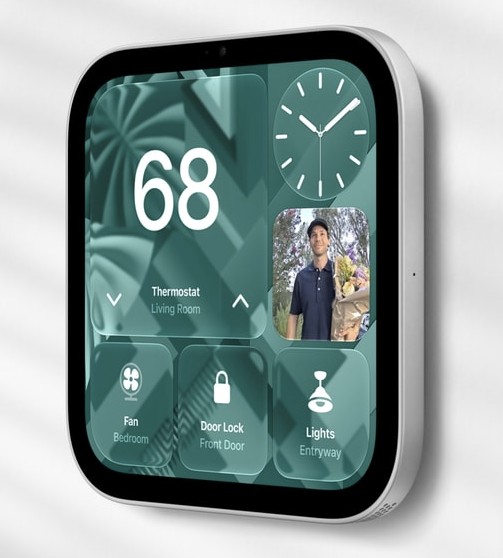
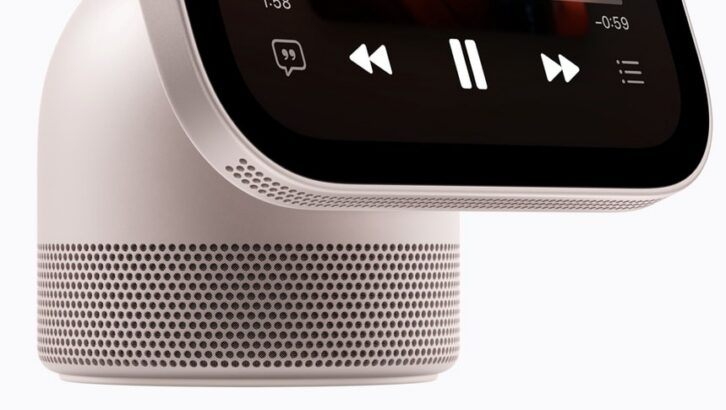
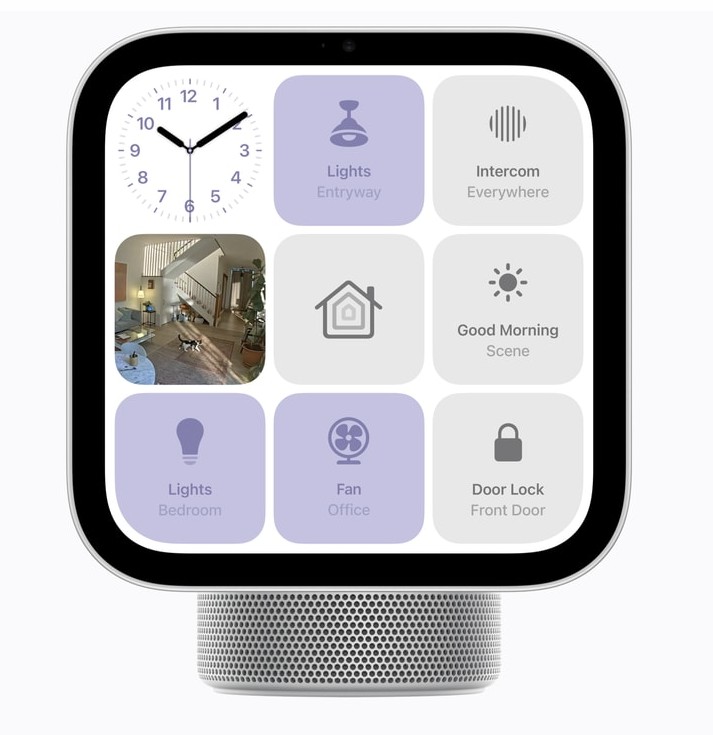
The “first of its kind for Apple” is the Apple HomeView. Some might call it Apple’s response to the well-established Amazon Echo Show line and similar products in the Google Nest universe, but it is more than that. There is a wall-mounted model and a tabletop version that conjures up what the love child of an old iMac and an Apple Watch might look like. There is a 7”, 1088×1088 Liquid Retina, backlit LCD, touch panel display with up to 500 nits of brightness. The camera is 12MP with Apple’s Center Stage technology.
For audio, in the base of the tabletop model there is a pair of full-range drivers in the display’s frame and both a downward-firing woofer and dual force-cancelling passive radiators in the base. The wall-mounted version has a pair of full-range drivers but no low-frequency driver.
On the hardware side, it is powered by the Apple A18 chip, has Wi-Fi 6E, Bluetooth 6.0, Matter and Thread border router support, has a four-mic array for noise suppression and Siri, and USB-C for both power connection and accessories. The camera is 12 megapixels with zoom for chatting if needed.

Both versions list at $299 with availability on Friday, November 13th, although the wall-mount model does not include either a mount or power adaptor. There are no VESA mounting holes on the wall-mount version, so you must spend $59.95 for the Standard mount or $129.95 for the AC-powered Premium mount that requires installation by an electrician, or $179.95 for the PoE Wired version. Both come from Schneider Electric.
At the top-level view, Apple HomeView is the natural integration of the disparate devices in the Apple ecosystem into a single device that keeps everyone in the house informed as to what is going on, enables spatial audio listening, video calls via FaceTime, locating family members with Apple devices using Find My, and viewing video content streamed from an iPhone or iPad.
That last item is key, as there are few embedded apps and there is no access to the Apple App Store. This isn’t a phone or tablet where you can ask it to play something directly from your favorite streaming service. You do that via AirPlay.
So what is it for? Apple presumably sees this as your home dashboard, with face recognition figuring out who is asking what. Yes, you can query it for sports scores, recipes, or similar, as you can with an Echo or Google device. However, as you will see when the three new products are wrapped together, there is much more, with the goal of all working together with Siri AI and the inclusion of Matter and Thread in the devices.
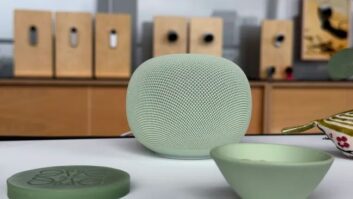
The third new Apple product is the HomePod mini 2, with a note that the larger, current HomePod Gen2 remains in the lineup at its $349 price. As its name implies, the $149 HomePod mini 2 is smaller, but with new features it is quite powerful in a number of ways.
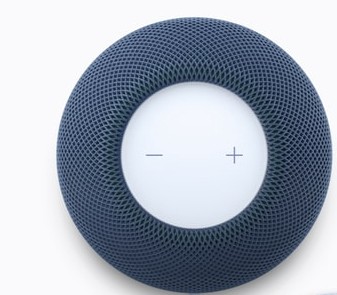 Designed to be both a standalone smart speaker and part of the larger Apple home products system, it, too, is designed to use Apple Intelligence to not only do the obvious music playback, but also to be part of the Apple home management system, taking voice commands for smart home device control, using Sound
Recognition to alert you if it hears smoke or carbon monoxide detectors, and even sending a notification of that to your iPhone, iPad, or Apple Watch.
The hardware side includes significant updates from the original HomePod mini thanks to an Apple S10 chip driving the system, Wi-Fi 6E and Bluetooth 6. The speaker is a single full-range driver, and the mic array has three far-field capsules. They will feed Siri and Siri AI when the latter is available down the road as a software upgrade.
New is the color-morphing Sound Glow surface at the top of the unit with a capacitive touch surface for control. There are now clickable, mechanical buttons.
Colors include white, pink, green, blue and midnight.
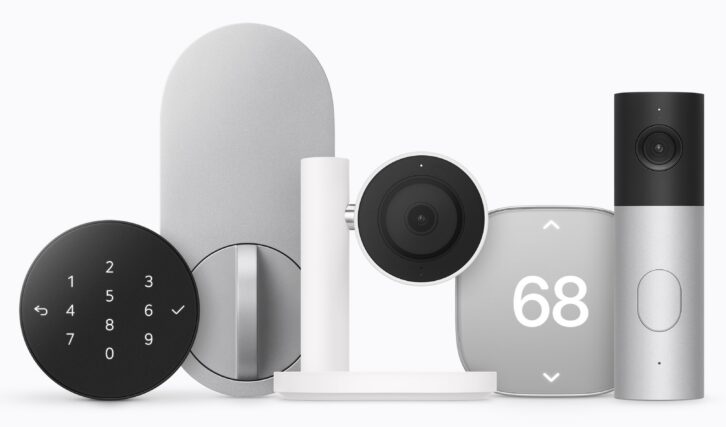
With those three new products joining the lineup, along with the HomePod and the Apple Home Collection from LG starting in December with a Video Wired Doorbell, an Outdoor Camera, and a Floodlight Camera. A Smart Thermostat and a Temperature Sensor and a smart thermostat that will become available in December, and then a Smart Deadbolt lock and Indoor Camera in January, 2027, the goal is a true, unified system with multiple control points.
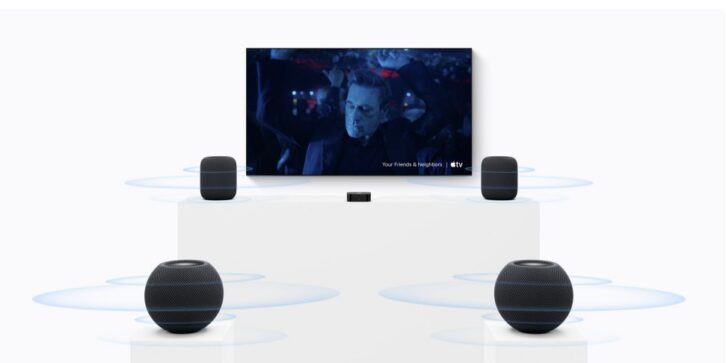
One key aspect of these devices and some of their earlier and present cousins is the ability of the new Apple TV 4K to work with a combination of four HomePod mini2 or HomePod Gen 2 products to create a fully immersive home theater surround system. Even better, with mics now embedded in the Apple TV 4K, you can not only talk to it without picking up the remote, but the mics and the processor also do all the configuration for the multi-speaker system. Position mapping, delay timing, level setting, room sensing, and dynamic EQ are all taken care of automatically. Thanks to the power of the A19 chip, a phantom center channel is derived, and the software distributes the LFE/bass channel across the speakers, with the heaviest bass routed to full-sized HomePods if they are at the front to keep deep rumble away from the smaller HomePod mini 2 when used as the rear speakers.
One presumes that other smart home products that already work with Apple devices will continue to work with the new models. The key thing to remember is that it doesn’t work the other way around, as the Apple-centric LG products will only work with the Apple devices. Yes, HomeView will respond on its own to anyone, but to set it up, a compatible iPhone or iPad is required, and the Home Collection products require an iPhone for initial NFC pairing. Similarly, certain personal context requests also require a paired Apple Intelligence-enabled iPhone or iPad running the latest software and having Siri AI turned on.
Siri AI is at the heart of all of this, and it is clearly new. Will it have growing pains? We’ll see. What will the daily limits for usage, if any, be? We don’t know yet. The fine print on all of this says that in the future there will be a fee for “expanded access,” but the “when” and “how much” are still to be determined.
If the family is all-Apple with reasonably recent devices, everyone should be happy. If it is a “mixed marriage” with a variety of Apple, Android, Amazon, and Google Nest devices, things should work, but to what extent is something that we won’t know until everyone gets their hands on them.
Put all together, this is a full-on effort to, at least for Apple families, deliver a complete home system including music and content, scheduling, queries on all subjects, view and control of smart home devices, locks, HVAC and cameras. With the HomeView providing the missing piece of the puzzle with a dedicated Apple display device, Siri SI, Apple Intelligence, and a new array of smart home products specially tailored to Apple, as our introductory song says, AT LAST. After all, the rest of the first lines are “My love has come along, And my lonely days are over, And life is like a song.”
To be certain, Amazon’s Echo and Echo Show devices, third-party Alexa-compatible devices, Google Nest Home products, and their first- and third-party products have quite a lead in this space for smart home devices and smart speakers. The same goes for the increasingly agentic AI functionality of Alexa and Google as the AI and software OS that drives their ecosystems. Will the allure of Apple’s industrial design, new product features, Siri AI combined with their tremendous market penetration for phones and tablets, push these new products to the top? That will be fun to watch, and at the very least, the competition will undoubtedly lead to better systems for all.
See also: Circana Forecasts Flat To Modest Growth For 2026 Holiday Spending