
New research from Omdia shows that the global smartphone market is undergoing a structural shift as rising component costs and geopolitical uncertainty push leading manufacturers to move away from low-cost, high-volume strategies and prioritize premium, high-value portfolios.
According to Omdia’s global smartphone forecast, total global smartphone shipments are forecast to contract by 12.2% year-on-year (YoY) in 2026, dropping to 1,093 million units. This represents a decline of 152 million units compared with 2025. Despite this shipment contraction, total market value is projected to grow by 6.1% YoY over the same period.
This divergence between shipment volume and market value is being fueled by a sharp rise in retail pricing. The global smartphone average selling price (ASP) is forecast to increase from $467 in 2025 to $565 in 2026. This 21% jump – equivalent to $98 – marks an all-time high in both growth rate and dollar value for the industry.
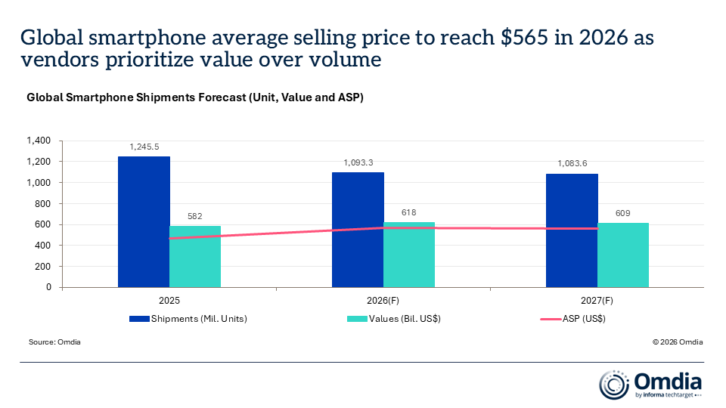
This pricing surge reflects severe margin pressures across the supply chain. Average DRAM and NAND flash memory prices rose by more than 80% quarter-on-quarter in 1Q26, with further increases already seen in 2Q26. While memory price hikes are expected to slow to single-digit growth rates in the second half of the year, component costs will remain structurally elevated, forcing vendors to pass some of these costs onto consumers.
Omdia forecasts that the global smartphone market contraction will extend into 2027, although the shipment decline is forecast to slow significantly to 0.9%. Even as memory prices are projected to begin correcting in 2027, the baseline cost of manufacturing sub-$100 smartphones is expected to remain too high to support significant decreases in end-user pricing.
Meaningful volume recovery for the industry is therefore expected to begin in 2028. Looking ahead, top global smartphone vendors are expected to remain highly conservative about expanding entry-level lineups. The ultra-low-end smartphone segment is projected to shift away from major global brands and towards smaller, local and regional manufacturers.
See also: The US Smartphone Market Has Declined 3% Year Over Year