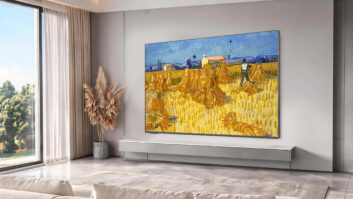
Samsung ended Sony’s seven-year reign as “King of TVs” at the 2026 Value Electronics TV Shootout, capturing top honors in the OLED competition ahead of OLEDs from Sony and LG.
Sony did capture first place in the event’s inaugural RGB-backlit LCD category.
In the OLED competition, Samsung’s 65-inch QN65S95H OLED totaled a combined average score of 9.3 in SDR and HDR testing, edging Sony’s 65-inch Bravia 8 Mark II OLED with 8 combined average points, and LG’s 65-inch G6 OLED finished third with 7.0 points.
In the RGB LCD competition, Sony’s 75-inch Bravia 9 Mark II earned a combined average score of 7.9 in SDR and HDR testing to easily edge Samsung’s 75-inch MRN75R95H at 6.2 points, and LG’s 75MRGB95BUA finished third with 5.2 total average points. TCL and Hisense were also invited to enter RGB LCD models but declined.
While new RGB LCD models were viewed by judges as falling short of OLED image quality, the upgraded mini-LED backlighting tech seems to have entered the premium TV conversation.
This year’s Shootout marked the 25th anniversary of the event created by Robert Zohn, founder of Value Electronics in Scarsdale, N.Y. Zohn founded Value Electronics with his wife Wendy in 1998.
“We started [the Shootout] in 2001, when I was just doing it for myself because I wanted to see who made the best TV,” Zohn remembered. “After about two or three years, I said, ‘Let’s make this public.’ This is fun!”
Since going public in 2004, the event has become one of the industry’s most closely watched evaluations of premium consumer TV display performance, usually attended by representatives from the TV makers.
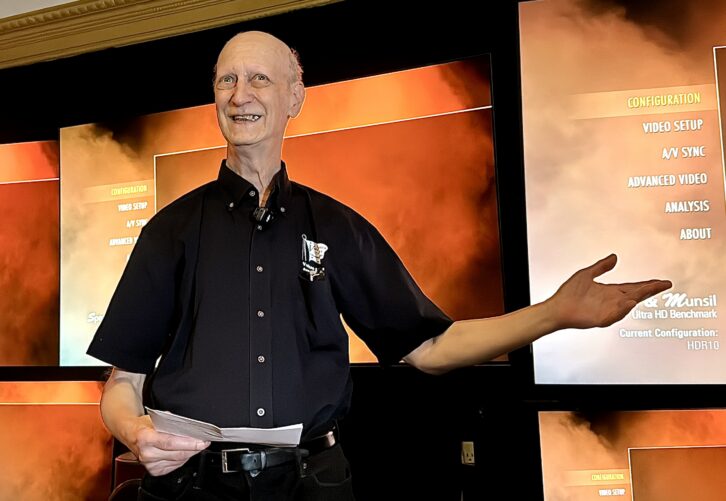
TV vs. Reference Monitor
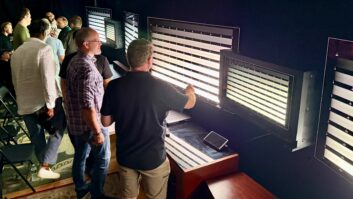
Unlike most TV comparisons, Shootout judges compare each OLED not against competing sets but against Sony’s professional BVM-HX3110 mastering monitors used in video production.
The judging panel included display calibrators, video professionals, and technology journalists, including former Consumer Reports TV engineer Claudio Ciacci, Chris Boylan of eCoustics and Big Picture Big Sound, Eric Masunaga of Modulus Studios, Nilay Patel of The Verge, and display reviewers Cecil Meade and Teyvon Pollard, among others.
Judges evaluated SDR and HDR performance using calibration patterns followed by scenes from films including 1917, The Batman, Nosferatu, Fantastic Beasts: The Crimes of Grindelwald, Mad Max: Fury Road, and Speed Racer. They scored shadow detail, color accuracy, HDR performance, processing, motion handling, and other picture-quality attributes on a 1 (worst) to 5 (best) scale.
OLED Still Improving

Although including RGB LCD was the biggest change to this year’s single-day event, OLED technology itself continues to evolve.
According to Shootout ringleader DeWayne Davis, a professional calibrator with Audio Video Fidelity and dubbed by Zohn as “probably the top calibrator in the world,” this year’s OLED improvements were more than incremental. These OLED improvements include WRGB technology implemented in some new LG OLEDs vs. quantum dot, deployed in the Samsung and Sony sets.
Davis explained that the WRGB layout has changed this year to reduce color fringing around letters, “which is really beneficial if you’re doing any graphic work, or you’re a gamer or something like that. But because of the change in sub-pixel layout, it has caused a side effect. When you go off axis, [the display] shifts green and…the field of view has shrunken up slightly from 32-35 percent…down to around 28,” which is “still significantly better than LCD, hands down,” Davis quickly added.
More broadly, recent OLEDs have upended long-held assumptions about the emissive and perennial top, TV tech vs. LCD backlit varieties.
For instance, OLEDs were once considered unsuitable for bright rooms, and ran hot and were expensive due to their high energy consumption.
But modern OLEDs have improved substantially in both brightness and energy efficiency. Davis argues that today’s OLEDs should handle virtually any normal home environment, especially considering their continued viewing angle advantage over any LCD backlighting alternative.
But mini-LED LCD backlit TVs retain one advantage over OLED: while OLED TVs top out at 77 inches, LCD models are available in far larger sizes.
RGB Joins Premium Conversation

While Samsung’s OLED victory ended Sony’s King of TVs winning streak, the significant development for retailers was the addition of RGB LCD backlighting technology to the event and as a new premium TV alternative.
Traditional mini-LED LCD televisions use white LEDs behind the LCD panel. RGB-backlit LCDs instead employ individual red, green, and blue LEDs, improving color performance while retaining LCD architecture.
However, the inclusion of RGB LCD models was driven primarily by organizers’ decision to combine what previously had been separate OLED and LCD evaluation days into a single event, making participation easier for judges, and not to equate RGB LCD picture quality with OLED.
“There’s so much buzz when it comes to the RGB-based backlight for LCDs that they’re superior to or can compare now to OLED,” Davis explained. “Okay, let’s put them through the run here.”
Premium TV Selling Challenge
However, once seen side-by-side with OLEDs, it was visually clear to even casual observers that OLED picture quality remains superior to the RGB LCDs, to the point that judges were reluctant to even judge them vs. the more tempting OLEDs. Davis was forced to jokingly “draft” several judges to test the RGB LCDs to ensure both technologies received equal platinum-eyed scrutiny.
But RGB LCD does create a new merchandising challenge, especially since the new RGB LCD models are priced virtually the same as same-sized OLEDs, and that long-standing OLED vs. LCD assumption no longer tells the whole TV tech choice story.
But with Sony, Samsung, and LG now offering both OLED and RGB LCD premium sets, retailers may want updated product training and selling guidance to help sales staff accurately explain the strengths and trade-offs of each premium TV tech. Sales associates increasingly will need to match each TV tech’s strengths to individual customer viewing environments and preferences.
Ultimately, the 2026 Value Electronics TV Shootout not only crowned two winners but also showcased the expansion of the premium TV category itself.