This is the first of a three-part series examining whether humanoid home robots are ready to become a consumer electronics category. Part 1 looks at where the technology stands today and what still needs to improve. Part 2 will examine whether robots should look like us — and whether consumers will trust them in their homes. Part 3 explores how home robots might actually be sold, leased, demonstrated, and serviced at retail.
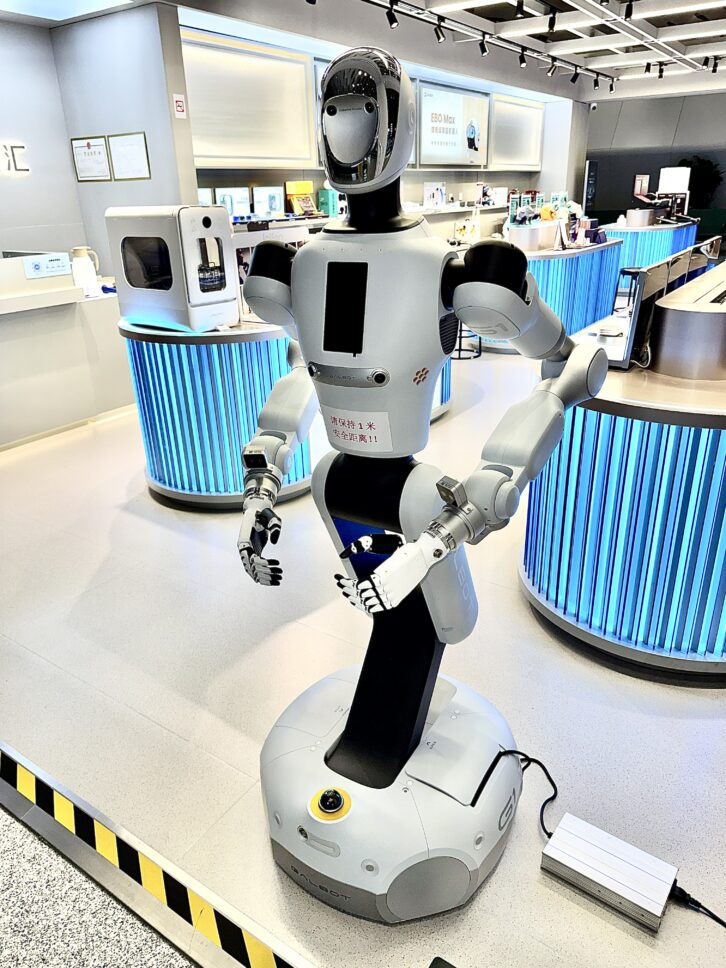
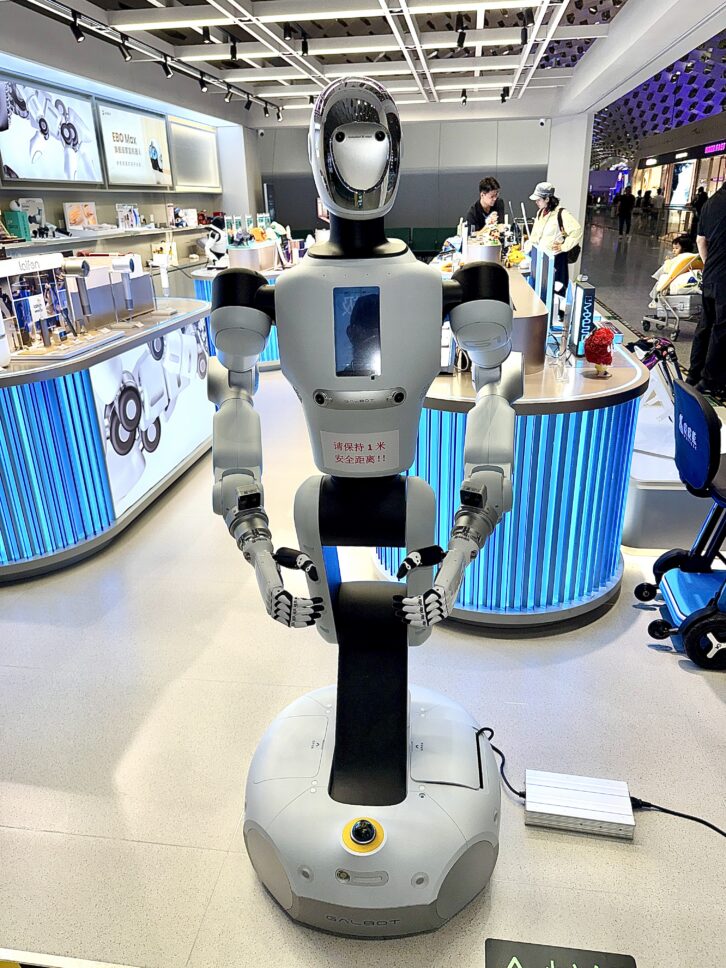
While wandering through Hangzhou’s airport-like high-speed rail station during a recent visit to China, I spied an otherwise nondescript small consumer electronics kiosk. Standing like a solemn sentinel fronting an array of miscellaneous gizmos and gadgets was something I had never seen offered for retail sale outside a trade show or research lab: a six-foot-tall humanoid robot.
I couldn’t find a price tag, which probably meant exactly what you’d expect, and the kiosk was ironically unmanned. (And, no, I didn’t try asking the robot.)
Humanoid robots are beginning to pop up as potential next must-have consumer gadgets at CES and other trade shows, the natural prelude to their appearance at retail. Aside from seemingly friendly, preternaturally choreographed dancing robots, these otherwise austere bipedal piles of metal and plastic are increasingly being presented as the next generation of that most prosaic household appliance: the labor-saving device.
U.S. retailers and consumers may soon face this homebot (my own “home robot” portmanteau) reality, though “soon” remains frustratingly undefined. Unitree Robotics founder Wang Xingxing recently estimated the industry could still be two to 10 years from its “ChatGPT moment,” which he defines as being able to drop a robot into an unfamiliar home and have it complete around 80% of tasks requested of it.
Meanwhile, robot manufacturers aren’t waiting. Multiple companies are already developing robots specifically for eventual home use and retail sale. At some point in the not-so-distant future, people could wander into a Best Buy or P.C. Richard & Son and walk out with a purchased homebot following dutifully behind. At least that’s what humanoid robot developers are aiming at and what tech retailers are hoping for.
But seeing a hulking humanoid robot inanimately standing inside a retail store doesn’t scream “labor-saving device,” at least to me. Like that homebot guarding the gadget kiosk in the Hangzhou train station, the appearance of a six-foot-tall humanoid robot screams “Danger!” (with apologies to Dr. Smith). I’m sure I’m not the only one.
So, will consumers want — or, more importantly, feel safe with — a homebot in their home, especially one with children or pets? And when will these machines become reliable, affordable, and supportable enough for retailers to actually sell them?
Whatever the answers, humanoid robots have suddenly become a real industry before they have become fully useful products that retailers can sell — at least not yet.
Uneven Development
 From a purely technical point of view, consumer homebots have only just begun taking their first, strictly supervised, hesitant steps out of the laboratory. UBS analyst Phyllis Wang estimated earlier this year that global humanoid robot shipments totaled around 10,000 in 2025 and could reach 30,000 this year, although she cautioned that an “EV moment” — when adoption suddenly accelerates — is unlikely within the next five years.
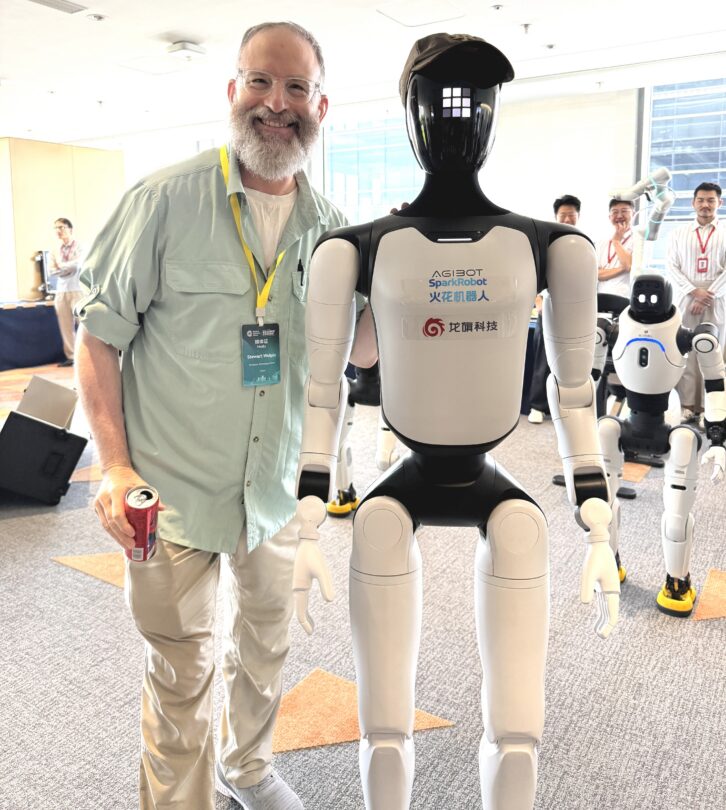
A surprisingly large roster of companies, including Unitree Robotics, 1X Technologies, Agibot, Figure AI, Tesla, Foundation Robotics, Genesis AI and others, are rapidly developing humanoids intended not simply for factories, hospitals and retail applications, but eventually homes. And some are already available to consumers: Unitree sells several humanoid robots directly online, including its $13,500 G1, while 1X is taking orders for its $20,000 NEO homebot, with U.S. deliveries scheduled to begin this year.
But being available to consumers and being ready for consumer retail are two different things, however.
Compance.AI CTO and co-founder Kadan Stadelmann points to 1X’s NEO as an example. “The 1X NEO shows real engineering progress,” he says, but it “doesn’t represent a gigantic leap that determines unsupervised humanoids will be moving in with us into our homes anytime soon.” General-purpose homebots, Stadelmann insists, “will be ready for consumer retail when they can navigate unstructured homes, manipulate disparate objects safely, and execute open-ended tasks with little supervision.”
The robotic development problem is that a homebot isn’t a single or even a tightly tied group of technologies progressing evenly apace. Instead, a homebot is an intricate combination of myriad intertwined hardware, software, and AI technologies, each advancing on its own uneven timetable.
“The development of humanoid robots isn’t determined by one technology,” agrees Bin Wan, chief operating officer of Chinese robotics company Keenon Robotics, during an extended discussion at the company’s Shanghai R&D center. “It depends on artificial intelligence, mechanical systems, sensing technologies, computing power, batteries and manufacturing — all developing together.”
Vishwanath “Vish” Hegadekatte, director of innovation at industrial technology and materials supplier Freudenberg Group, looks at the uneven development of homebot technologies from the physical side. Homebots require joints and actuators capable of surviving thousands upon thousands of repetitive movements, along with reliable motors, batteries, seals, vibration control, and sound dampening. Consumers who spend thousands of dollars for a machine to eliminate household chores, Hegadekatte notes, aren’t likely to tolerate one that regularly overheats, becomes noisy, or requires frequent maintenance.
Genesis AI has reached a similar conclusion about integrating intelligence and hardware. The company’s Gene robotics foundation model — essentially the AI “brain” intended to operate its robots (currently in version 26.5) — was originally the primary goal. But Genesis co-founder and CEO Zhou Xian told TechCrunch that the company concluded it also needed control of the hardware and decided to “go full stack.”
Stay Slow, Steady — and Safe

This uneven robotic development helps explain one of the first things one notices watching the current generation of autonomous homebots operate: they’re slo-o-o-ow.
Identify a cup. Pick it up. Carefully place it elsewhere. All this takes watching-paint-drying time that tempts us to just grab the damn cup and move it ourselves.
Safety accounts for some of this deliberate robot pace. But “the limit isn’t the motors,” explains Carnegie Mellon University mechanical engineering associate professor Ding Zhao. “It’s the ‘big brain’ behind them not yet processing everything fast enough in such a compact package.” Zhao compares the problem to how long it once took to load a single Internet image compared to today.
Homebots need time to comprehend what they’re sensing before determining what to do next. Unlike industrial robots repeating a limited number of identical programmed motions, a homebot must operate in ever-active environments filled with constantly moving people, pets, and both moving and seemingly stationary objects. Then the homebot must decipher and understand the physical relationships among these unpredictable…things, anticipate what each might do next — all without inflicting harm or damage, and all in real human time.
“The hardest problem is no longer making a robot do something impressive once,” observes Jerry Wang, global president of Faraday Future and president and global chairman of AIxC, the company’s robotics-focused AI subsidiary. “It is making it do something useful a thousand times in the unpredictable real world.”
How Smart Are Homebots?
Aside from the 10% chance that it will exterminate humankind before homebots even appear at retail, large language model (LLM)-based consumer AI chatbots have become remarkably adept at recognizing objects in photographs, answering complex questions, carrying on meandering conversations, and offering instruction and advice — correct, incorrect, misleading, or actually harmful — on nearly any subject.
But getting AI in a humanoid metal body to perceive, reason, decide, and physically act in an unpredictable four-dimensional environment — increasingly referred to as Physical or Embodied AI — is considerably harder.
For homebots, Wang says, “perception has to become human awareness.”

Janis Skriveris, principal at global venture-capital and innovation firm Plug and Play, describes Physical AI as a continuous “sense-reason-act” loop in which a machine perceives its surroundings, builds an understanding of what’s happening, and decides how to respond without a human in the loop. “A robot vacuum is a very early, simple version of this,” Skriveris observes. A homebot moving speedily, suitably, and safely among people is vastly more complicated.
Recognizing an object as a child, Skriveris explains, is one thing. Understanding that the child is fragile, moves unpredictably, and may suddenly dart in front of or reach toward the robot is something else entirely. Current systems handle recognition reasonably well but still struggle with “edge cases” — unusual, unexpected situations that nonetheless occur routinely in messy real homes. A humanoid operating in a kitchen, Skriveris adds, is “the hardest version of this problem anyone has ever tried to solve.”
Physical AI also faces a singular training problem. LLMs draw from an enormous existing corpus of digital data. However, there is no comparable compendium of life’s myriad IFTTT unpredictability — every possible way a glass or cup is shaped and how strong it is, how an almost imperceptible facial expression or vocal tone can radically alter the meaning of an otherwise mundane statement or command from sarcastic to serious to whimsical, how animals or children suddenly appear and act without logic, or the entire concept of appropriate human physical space.
Think about Schwarzenegger’s Terminator green-text scans as it/he determines who, what, when, where, and why, then decides how to appropriately act — all in seconds. But in Terminator 2: Judgment Day, we also see the friendly Terminator being taught 1990s social behavior by the young John Connor: “No, no, no. You gotta listen to the way people talk! See, you don’t say like ‘Affirmative’ or some shit like that. You say… no problemo.”
That, in an admittedly Hollywood nutshell, is part of the Physical AI problem: simply identifying what something is doesn’t necessarily tell a robot what it means or how to behave around it.
Robot Training
Unlike LLMs, homebots can acquire much of their missing physical-interaction data only by learning from the physical world. Developers use several approaches, including repeatedly guiding robots through tasks in the lab so their AI models learn the movements, sometimes like puppets, as well as simulation and human demonstrations, to essentially create the robotic equivalent of muscle memory.
Genesis, for instance, trains its Gene AI model with simulation, Internet video, and data captured as humans wearing sensor-equipped gloves perform physical tasks. The gloves record hand movements and forces that Gene AI learns to reproduce. Xian told TechCrunch that Genesis initially focused on developing the AI model, but eventually concluded it needed to control the robot hardware as well — hence its decision to develop the two together “full stack.”
Wang sees real-world deployment as another essential source of Physical AI training data but adds a caveat any CE retailer who has survived a problematic Version 1.0 product will instinctively understand: “Customers should not be beta testers for unsafe hardware.”
That doesn’t mean today’s homebots are stupid. It means that, at the moment, homebot intelligence remains much more useful under controlled conditions than amid the barely controlled chaos of a home.
Even so, Stadelmann opines that “issues must be addressed across perception, cognition, and action” before they can coordinate reliably across their full technology stack in busy domestic environments.
Homebot Use Cases
 So what can an autonomous homebot reliably do today?
According to Wang, it can navigate a home, recognize common objects, and pick up and carry rigid objects from one place to another.
“That’s it.”
But this limited functionality list may prove more expansive than it sounds. Wang believes one early application could be an overnight “room reset,” with a homebot gathering toys, clothes, shoes, cups, and other household clutter and returning objects to their proper places while everyone sleeps. These are tasks for which human speed is largely irrelevant.
“Slowness is free at 3 a.m.,” Wang notes.
And how will we know when the technology has finally crossed from gee-whiz demonstration to useful labor-saving appliance?
“You’ll know the shift has happened when people stop filming the robot and start getting annoyed when it skips a night.”
In other words, like a baseball umpire, you notice it only when it screws up.
Which may be a more meaningful benchmark for homebot readiness than how fast one can run, dance, or perform a backflip.
Because getting a robot to work with us is only the first problem. Getting us to buy and live with one is quite another.
See also: Shure, Sony Bring Immersive Audio Mics To Mainstream Retail