 LG Display has developed a new OLED production method that eliminates the use of fine metal masks (FMMs), potentially improving panel brightness, lifespan and power efficiency.
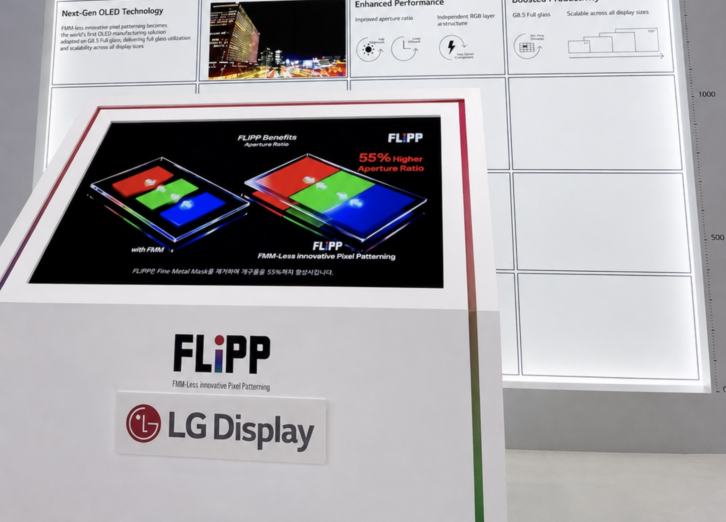
Called FMM-less Innovative Pixel Patterning, or FLiPP, the process uses photolithography and precision UV light to pattern RGB pixels. Rather than using a fine metal mask to deposit OLED materials, the process coats RGB pixels in sequence and removes unwanted material through UV etching.
According to LG Display, eliminating the FMM allows individual subpixels to be positioned closer together, increasing the portion of the display occupied by RGB pixels. The company says FLiPP improves the aperture ratio by approximately 55%.
“Compared with panels produced using FMMs under identical conditions, FLiPP enables displays to increase brightness by 1.6 times, extend lifespan by 2.4 times, and reduce power consumption by 13%,” says LG. “This is because FLiPP improves the aperture ratio – the proportion of the total display area occupied by RGB pixels – by approximately 55%.”
The process also addresses some of the manufacturing limitations associated with FMMs. Fine metal masks can become more difficult to manage as panel sizes increase, while changes to panel size or resolution can require new masks. Removing the masks could also reduce production costs.
LG Display demonstrated FLiPP at the International Meeting on Information Display (IMID) 2026 in Busan, South Korea. The company has applied the technology to an 8.5-generation mother glass, a format measuring approximately 2,200 x 2,500 millimeters. LG Display says using the larger substrate without the limitations of FMM processing can improve manufacturing efficiency.
LG Display has not yet provided a commercial production date for FLiPP. The company said the technology could provide greater flexibility in OLED manufacturing and eventually be applied across a range of display sizes and applications.
See also: Dolby Vision 2 HDR Is Officially Arriving On Certain Hisense TVs