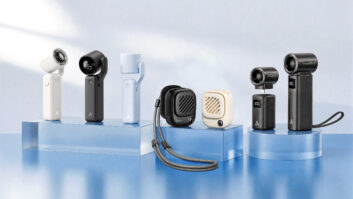
Engineering samples of xMEMS’ Sycamore and Cypress MEMS (micro-electromechanical systems) nearfield full bandwidth speaker chips, along with the company’s µCooling thermal management “air pump on a chip” cooling tech, will be available before the end of this year.
Sycamore and µCooling solutions are due to move into mass production in Q2 next year, while Cypress chips for TWS headphones are now mass production-ready. Vendors will be able to start shipping next-gen devices equipped with xMEMS’ latest chips and cooling architecture by next fall.
xMEMS’ new speaker chips will allow makers of smart glasses, headphones, TWS earbuds, smart watches, and other personal and wearable tech to shrink, lighten, provide fuller audio capabilities, occupy less space, and elongate battery life.
“As LLMs [large language model AI] start to migrate more from the cloud into these electronics, how do we have more convenient access to the information we need?” Mike Housholder, VP Marketing and Business Development at xMEMS Labs, rhetorically asks. “Audio is going to play a key role in that, particularly voice. So getting voice clarity in noisy environments is going to be really important.”
As AI shifts from the cloud to local device access, Housholder notes, wearables, already supporting a slew of processor-heavy A/V and connectivity functions, are going to experience a higher processor load, generating a lot more heat that both throttles performance and could make the device too hot to wear. xMEMS µCooling architecture addresses both throttling and surface heat issues, as well as keeping the inside of headphone cups moisture-free over lengthy wear periods.
“How do we keep those devices cool and running at their optimal performance?” Housholder additionally poses. “Since a lot of these AI interface devices are going to reside on the body, keeping case temperatures cool is also a matter of consumer safety and comfort.”
Sycamore Details

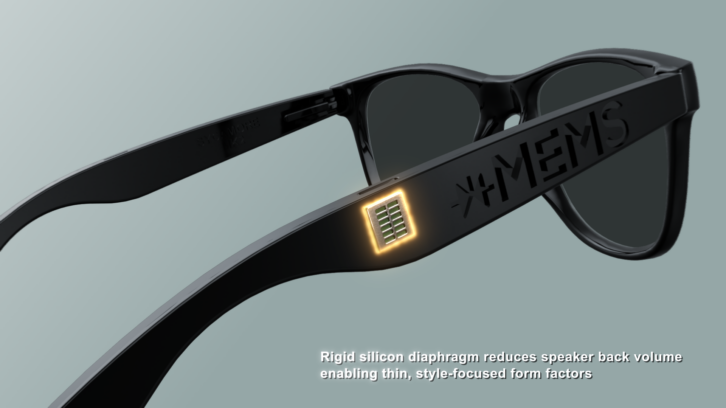
Solid state Sycamore near field MEMs speakers measure just 1mm thin, 67% thinner than a coil speaker, in a 70% smaller package that requires less back volume, and up to 90% lighter versus a dynamic driver.
xMEMS boasts a single Sycamore-based headphone speaker plate capable of producing full bandwidth audio in free air weighs just 18 grams compared to around 42 grams for a conventional 50mm driver assembly, a 57% weight reduction that enables dramatically lighter and more comfortable headphone designs. A Sycamore speaker plate solution is 67% thinner than a traditional dynamic coil speaker, 70% smaller, with up to 90% weight reduction versus a dynamic coil driver, according to xMEMS, all of which frees up space for a larger battery.
Yet, xMEMS asserts the Sycamore speaker assembly delivers full sound in what seemed an impossibly light test headphone, TWICE was able to audition.

Sycamore will be available in four configurations:
- Sycamore Square: 8.4mm x 9xx x 1.13mm, with a top-fire speaker capable of 200Hz: 76.5dB and 1kHz: 88dB output
- Sycamore-NC: 19mm x 5.3mm x 1.28mm, with corner-fire, 200Hz: 76db and 1kHz: 88db output
- Sycamore-DCQ: 17.2mm x 8.4mm x 1.28mm, with corner-fire, 200Hz: 78dB and 1kHz: 91dB output
- Sycamore-W: 19mm x 4mm x 1.28mm, with top-fire 200Hz: 76dB and 1kHz: 89dB
xMEMS will work with a manufacturer to choose the most appropriate chip for a specific device and application. In addition, “customers are coming to us with unique form factors, and saying, ‘Hey, could you build this for us?’” Housholder relates. “And, yeah, for the right money, yes, we can build a custom one of these that would be appropriate.”
Housholder does admit the Sycamore will initially present about a 2x price increase over traditional headphone speakers. But Housholder also notes that wearable product makers are “desperate to solve the weight problem. We give them a path to solve that. The dynamic coil speaker will never solve that. We are the only solution. We are not going to be a cheaper solution, but that price delta will shrink over time.”
Smart Glasses Shrinkage
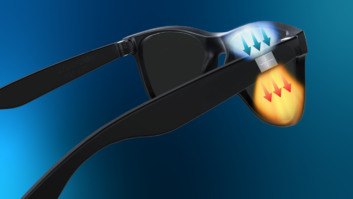
For the growing smart glasses space, Housholder believes Sycamore solves specific problems that could otherwise restrict mass market adoption. Currently, most smart glasses weigh in at 49 grams or more, while the target weight for most standard dumb glasses is 30 grams or less. Sycamore’s smaller size can also shrink the size of currently bulky smart glasses temples.
“If we look at the smart glasses use case, all day wear, weight, thinness, and fashion are key,” Housholder notes. “Some people wear bulky glasses really well, and it’s a fashion statement for other people. But thin and unobtrusive is the way to go. If you’re at 48-49 grams today, you can remove six grams. It doesn’t get you to 30 grams, but it gets you a heck of a lot closer.”
But size and weight are not the only upgrades that Sycamore could bring to the next generation of smart glasses. Housholder notes that Sycamore can not only output more powerful, higher-quality audio, but the piezo structure of the Sycamore could translate to a 50% power savings when played at higher volume.
xMEMS also recently announced that its smaller Cypress full-range MEMS speaker, designed for TWS ear buds, together with the Alta-S companion drive ASIC (application-specific integrated circuit), is available for sampling and ready for mass production with shipments expected in 2026. According to the company, Cypress-equipped buds can achieve wider-bandwidth noise suppression, improved passive noise isolation, and unprecedented sound clarity in a package measuring just 46mm and weighing only 98mg.
Cooler Chips, Wearables
Along with smaller speaker assemblies, xMEMS has begun sampling its silent and vibration-free µCooling MEMS micro “air pump on a chip” architecture – a chip that actually blows out component-cooling air to dissipate heat.
“[Vendors] have a thermal envelope that [they] need to fit into, so this gives you more headroom to run the processor harder so it’s not throttling within the same thermal envelope,” Housholder expounds. “Or you could say my problem is temperature. I don’t need more MIPS, I just need lower temperature because otherwise your ear will get hot, and the phone will get hot. Now I can run at the same mix, but at a lower temperature.”
µCooling architecture is designed to solve several problems in varying mobile, personal, and wearable devices. In processor-heavy devices, µCooling not only reduces heat-induced processor throttling to allow heavier processor loads but also makes wearables more comfortable.
In a demo, µCooling cooled a processor from 86c – nearly 120 degrees Fahrenheit – to 76c in about 90 seconds. For wearables, IEC (International Electrotechnical Commission) sets 48c as a maximum surface temperature for touch duration of more than a minute. But “most manufacturers we’re talking to are targeting 41-42c, and we’re showing them getting well down to 37c,” Housholder relates. “That will enable comfortable and safe AI glasses that can touch your skin all day.”
At the recent Live Asia 2025 seminar series, xMEMS demonstrated smart glasses one-twentieth the weight of current models with 10c lower surface temperatures, as well as a smartphone with up to 25% component temperature reduction and a 15% lower surface temperature reduction.
In headphones, µCooling, combined with specially designed micro vents, can reduce moisture and humidity that develops inside earcups during extended wear by 85% in less than five minutes. Despite the movement of cooling air inside headphone earcups “close to your ears, close to your head,” Housholder insists, “you’re not going to hear anything, no fan noise.”
For larger devices, xMEMS has designed a PCB that can hold multiple chips with etched micro channels on the backside for air to escape and cool the chips from underneath.
See also: How Context-Aware Edge AI Sensors Will Redefine Consumer Electronics