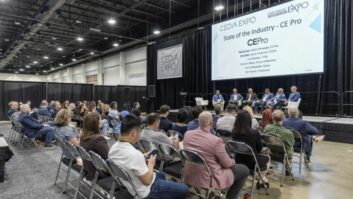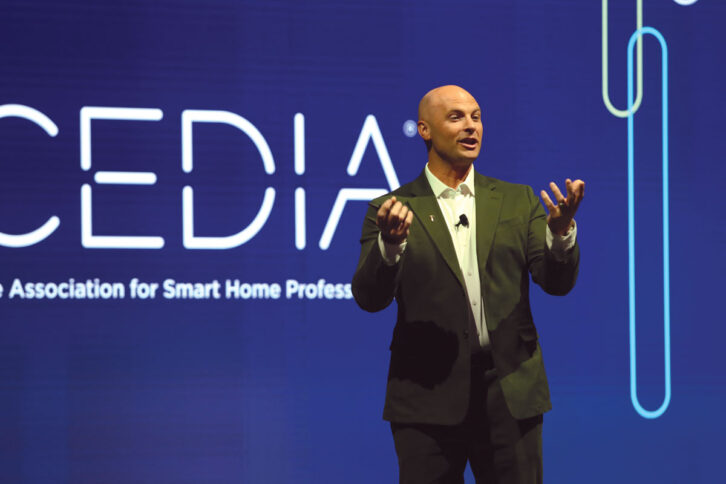
Collaboration is crucial for integrators to build their business, said Chip Wade, a keynote speaker at CEDIA Expo/CIX 2025 in Denver. Wade shared his journey from HGTV host to business owner on Thursday morning in “Beyond the Blueprint: Where Innovation Meets Intention.”
An Atlanta native, Wade earned a degree in mechanical engineering from Georgia Tech, but his career path hasn’t followed the traditional blueprint for success. He took a detour into the media industry when he auditioned for HGTV.
Wade appeared on Designed to Sell in 2007, marking his first foray into the home improvement arena. He also hosted Elbow Room on HGTV for four seasons, from 2012-2015. Elbow Room featured innovative solutions for families looking for more space in their current homes.
In 2008, Wade founded Wade Works Creative, an architecture and design, real estate, and production company. While the company only has three employees, Wade has established relationships with other home professionals to complement his expertise.
Wade said integrators should focus on developing relationships with designers, architects, and contractors, who often receive the first call from homeowners about projects. “A lot of my business comes from relationships I’ve built over the years,” Wade said.
While the end consumer might not know what an integrator does, establishing relationships with designers can help integrators start the process before any work is done on home renovations. “By the time the contractors come in, there’s a lot of stuff in motion,” Wade said.
In his presentation, Wade shared a three-step process to create home installations that exceed expectations for the consumer: Identify challenges and needs, brainstorm and be curious, and create a vision that excites.
He also emphasized that he provides his customers with multiple scenarios that showcase the latest in smart home technology. Customers might not be familiar with all the latest technology; integrators should focus on the experience that the technology provides rather than on detailed specifications.
“We do a lot of upselling, but I call it vision casting,” Wade said. He also underscored the importance of providing 3D renderings to showcase the designs. Wade offered a glimpse of some of his unique projects, which ranged from a sunken art studio to a topographical wall printed on laminate.
While Wade serves as the main point of contact, he encourages integrators to approach installations as a team effort. He also said challenging projects can be frustrating, but they can also offer integrators a chance to shine.