Consumer electronics and appliance businesses selling into Europe now face a repair obligation that can land well beyond the factory.
Directive (EU) 2024/1799, the EU’s right-to-repair law, became applicable on July 31, 2026. It was written to make repairs easier for consumers. For the trade, it creates new compliance, cost, and contract questions, especially where the brand behind a product is based outside the EU.
The covered categories read like a CE and major appliance floor plan: televisions and electronic displays, smartphones, cordless phones, tablets, vacuum cleaners, washing machines, washer-dryers, tumble dryers, refrigerators, and dishwashers. Servers and data storage products, welding equipment, and goods containing batteries for light means of transport, including e-bikes, round out the list.
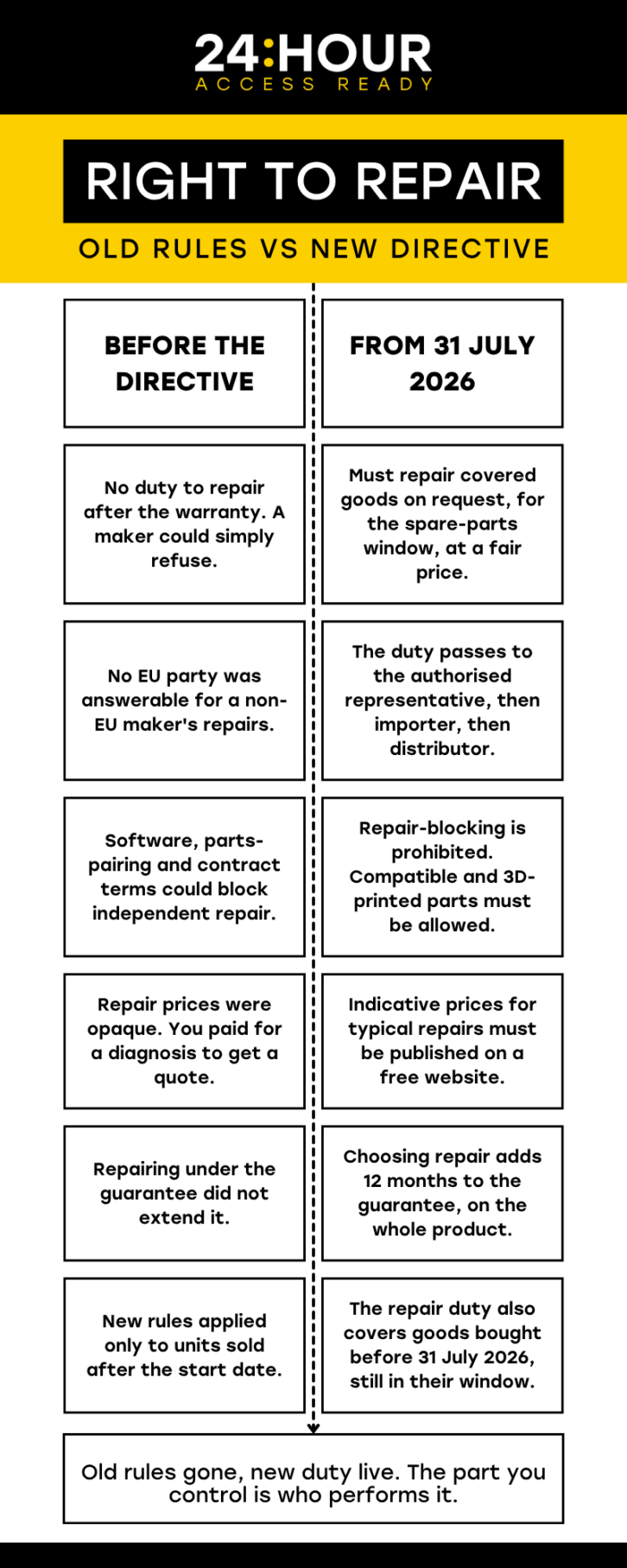
The most significant change for the supply chain is this: when the manufacturer is outside the EU, the legal duty to repair can pass to its EU authorized representative, then to the importer, and finally to the distributor if there is no importer.
That means businesses need to know not only whether a product can be repaired, but also who is legally responsible for making sure it is.
What Changed?

Until now, a customer with a faulty TV or phone relied on the seller’s legal guarantee. The new directive leaves that framework in place and adds a separate repair obligation on top of it.
Where repairability requirements apply and a repair is technically possible, the manufacturer must repair a covered product when the consumer asks. The repair must be free or offered at a reasonable price, and completed within a reasonable period.
This obligation applies to repairs outside the seller’s liability under the existing legal guarantee. In practice, that means the post-warranty years, which is where most CE service revenue and cost has traditionally lived.
Articles 5 and 6 of the directive apply only to goods for which repairability requirements are set by the EU legislation listed in Annex II. That is why the list above is specific. A product either falls under one of those ecodesign-style measures or it does not.
The directive also extends the seller’s liability period by 12 months when a consumer chooses repair over replacement for a product that fails under warranty. The seller must inform the consumer of this right. This extension applies to sales contracts concluded on or after July 31, 2026. The separate repair obligation applies to covered products that meet the directive’s scope and applicable repairability requirements.
For the trade, the shift is from treating repair as a consumer remedy to treating it as a supply-chain responsibility.
Where the Obligation Lands
 Article 5 sets out a clear chain.
If the manufacturer with a repair obligation is established outside the EU, its authorized representative in the EU must carry out that obligation.
If there is no authorized representative, the duty passes to the importer.
If there is no importer, it passes to the distributor.
Each party in that chain can subcontract the physical repair work. Subcontracting does not remove the underlying legal obligation.
This matters for any distributor or retailer that has assumed the overseas brand will handle service. An importer may find itself responsible for a product it did not build. A distributor can inherit the same duty if no importer sits above it.
The resulting costs can include the repairs themselves, reverse logistics, spare parts inventory, service contracts, and renegotiated supplier terms. For companies already working through the federal tariff refund process and other import cost changes, this adds another line to the landed-cost calculation.
About the Author
Ferry Vermeulen is the Co-Founder of 24hour-AR, a company dedicated to providing authorised representative services as well as CE marking services. With a background in industrial design engineering, Ferry specialises in facilitating swift compliance with EU regulations, enabling manufacturers to enter markets seamlessly.
See also: Selling New Robot Vacuums Just Became Much More Difficult