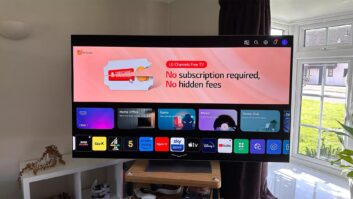
Santa Clara, Calif. – Nearly 20 percent of all TVs shipped in
2010 featured connected TV capabilities, according to new research released Monday
by DisplaySearch.
The DisplaySearch Q1 2011 Quarterly TV Design and Features
Report, predicts the connected TV category to grow to over 123 million shipments
in 2014 (at a 30 percent compound annual growth rate).
Emerging markets will play a major role in this growth, the firm
said, with Eastern Europe forecast to grow from 2.5 million connected TVs
shipped in 2010 to over 10 million in 2014.
In addition, DisplaySearch findings indicate that 33 percent of
flat panel TVs sold in China in 2013 will have internet capability.
“The connected TV market is developing beyond mature regions like
Western Europe and Japan,” said Paul Gray, DisplaySearch TV electronics
director. “With some emerging countries having excellent broadband
infrastructure, the adoption of connected TV capabilities is a natural next
step in TV feature innovation.”
In developed regions, connected TV is a second wave following on
the heels of digital broadcasting. In China, however, the adoption of
connectivity is occurring in advance of digital terrestrial television (DTT)
adoption.
As a result, TVs shipped into this region can decode video from
the internet, but not from terrestrial broadcast.
DisplaySearch said it is expecting a surge in China driven by
decoder chip costs reaching a tipping point, with current low cost for such
capability.
The connected TV market, DisplaySearch said, will become
fragmented and increase in complexity.
“Basic connected sets carrying enhanced broadcast services such
as Hbb.TV or basic video on demand (such as Netflix, Maxdome, Acetrax or VUDU)
will appeal to consumers who expect TV to remain a passive experience,” the
report said. “For more adventurous consumers, the smart TV segment will enjoy
configurable apps, sophisticated search and navigation engines, and advanced
user interfaces.”
DisplaySearch defines a smart TV as a TV that can retrieve
content from the internet without the restrictions of a portal, has intelligent
search and recommendations, is upgradeable by its owner, and is able to network
seamlessly with other devices in the home.
Gray added, “Smart TVs are adding to what is already a
fast-moving and fiercely competitive battleground, with competition appearing
in all directions, including mobile PC devices such as tablets and increasingly
powerful set top boxes with services accessible anytime, anywhere.”
The report compares the connected TV strategies major TV brands.
For example, Panasonic is opting to locate intelligence in the cloud, while
Samsung is building the capability into the device.
Other new capabilities reviewed in the report include the RVU
standard that allows connected TVs and set-top boxes to share pay TV content,
and low-power sets that can operate with no power cord using only an Ethernet
cable.
The DisplaySearch Quarterly TV Design and Features Report is a
quarterly update of the issues and rapid shifts in feature development in TV
sets.
To obtain a full copy of the report contact Charles Camaroto at
.